Rivermont Historic District (Additional Documentation)
Also known as: 118-0334

Why it's listed
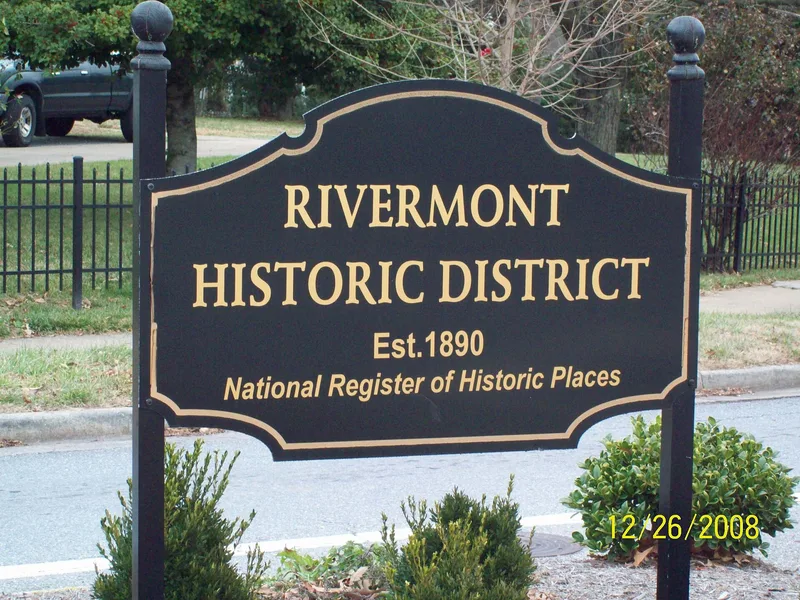
Rivermont is a planned streetcar neighborhood in northwest Lynchburg, Virginia, laid out along curving Rivermont Avenue and bounded by the James River, Blackwater Creek and steep hills. The Rivermont Land Company, founded in 1890, platted the streets and lots, set building requirements such as setbacks and minimum costs, and joined the area to downtown by the Rivermont Bridge. The district covers about 192 acres and includes houses, duplexes, apartments, shops, churches, schools, a fire station, a library, hospitals and parks. Its buildings represent nearly every major style of the late 19th and early 20th centuries, from Queen Anne to Colonial and Tudor Revival. Local architects such as Edward G. Frye and Aubrey Chesterman designed many of them. Randolph-Macon Woman's College, founded in 1891 on land donated by the company, anchors the district, and several gardens were designed by Charles Gillette. Most of the 384 resources are historic and in good condition.
Significance in brief: The nomination argues the district is Lynchburg's first planned streetcar community, combining homes, shops, schools, churches and green space with a transit line as part of the design. It also holds a cohesive collection of late 19th and 20th century buildings in nearly every major American style, many by leading Lynchburg architects and others from Boston, Washington and New York. Gardens by landscape architect Charles Gillette add to its interest.
Machine-generated summary. This summary was generated by a language model from the official nomination document and has not been reviewed line by line by an editor. It may contain errors. Check the source document before relying on any detail. Source: nomination document (PDF) · National Archives catalog entry. NRHP reference 03000224, listed April 11, 2003. Summary generated October 2026 (model claude-sonnet-5-5, prompt v1.0-2026-10-29, confidence medium).
Key facts
| Address | Rivermont Ave, Lynchburg |
|---|---|
| County | Lynchburg |
| Listed | April 11, 2003 |
| Reference number | 03000224 |
| Resource type | District |
| Architect / builder | Edward G. Frye, Aubrey Chesterman, J.M.B. Lewis, Stanhope Johnson, Preston Craighill, Bennett Cardwell, Bryant Heard, Pendleton Clark, Everette Fauber, Walter Crowe, Ralph Adams Cram, William M. Poindexter, Penrose Stout |
| Architectural style | Queen Anne; Beaux Arts; Classical Revival; Colonial Revival; Spanish Colonial Revival; Bungalow/Craftsman; Tudor Revival; Georgian Revival; Italianate; Commercial Style; Romanesque Revival; Gothic Revival |
| Criteria |
|
| Areas of significance | Architecture, Community Planning and Development, Religion, Education, Commerce, Entertainment/Recreation, Health/Medicine, Landscape Architecture |
| Level of significance | Local |
| Status (as stated in the nomination) | Most resources are in good or excellent condition; about 82% of the 384 resources are historic and 18% are non-contributing. |
| Acreage | 192.1 |
| Coordinates | 37.42778, -79.15465 (NPS GIS) |
What listing means for this property
This is a historic district. Buildings within its boundary are either contributing (they add to the district's significance) or non-contributing. Owners of contributing income-producing buildings can claim the 20% federal rehabilitation tax credit; homeowners should look at state credits. National Register districts impose no design review by themselves; a local historic district ordinance, if one exists, does (the difference explained).
General information, not legal or tax advice. Rules change; confirm with your State Historic Preservation Office or a qualified adviser.
Sources and further reading
- National Park Service, National Register of Historic Places database (snapshot May 2026), reference 03000224.
- Nomination form (PDF, National Archives) — catalog entry
- Wikipedia article (used for cross-checking only; text not reproduced here)
- Wikidata Q7338271
- This listing as JSON
Last updated October 2026. Found an error? See the editorial policy for how to report it.