Gloucester Downtown Historic District
Also known as: Gloucester Court House; 036-5106

Why it's listed
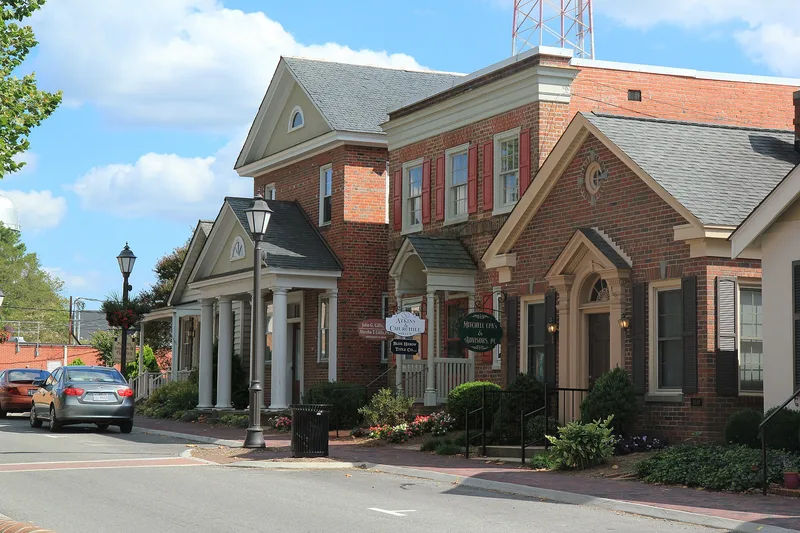
Gloucester's downtown is a seven-block stretch of Main Street in Gloucester Court House, Virginia, beginning at the courthouse circle and ending near Ware House Road. The county seat grew around a courthouse site used since about 1680, and the Main Street link to it appears on a 1754 plat. The town was formally established in 1769 as Botetourt. Along the street stand the 1766 Georgian courthouse, the c1774 Botetourt Hotel, a Masonic lodge from 1857, Classical Revival banks from 1902 and 1916, and the eighteenth-century Longbridge Ordinary, later home of the Gloucester Woman's Club. Twentieth-century additions include early gas stations, a 1950 Moderne Coca-Cola bottling building and mid-century stores. Intact archaeological deposits lie beneath the courthouse green and several other lots. The district retains its historic layout and most of its buildings. It is significant for archaeology, architecture, commerce, African American heritage, government and law between 1754 and 1960.
Significance in brief: The district shows how a rural county seat grew from an eighteenth-century legal and administrative center into a commercial small town. It keeps its original Main Street plan and a wide range of building styles, along with archaeological sites. It is significant for archaeology, architecture, commerce, African American ethnic heritage, government and law.
Machine-generated summary. This summary was generated by a language model from the official nomination document and has not been reviewed line by line by an editor. It may contain errors. Check the source document before relying on any detail. Source: nomination document (PDF) · National Archives catalog entry. NRHP reference 10001063, listed December 28, 2010. Summary generated October 2026 (model claude-sonnet-5-5, prompt v1.0-2026-10-29, confidence medium).
Key facts
| Address | Seven blocks of Main St from the courthouse circle to Ware House Rd, Gloucester |
|---|---|
| County | Gloucester County |
| Listed | December 28, 2010 |
| Reference number | 10001063 |
| Resource type | District |
| Period of significance | 1754-1960 |
| Architect / builder | C. T. Holtzclaw of Hampton, VA (designer of the 1916 First National Bank building) |
| Architectural style | Colonial/Georgian, Federal, Italianate, Queen Anne, Colonial and Classical Revival, Commercial Style, Moderne, Art Deco |
| Criteria |
|
| Areas of significance | Historic - Non-Aboriginal, Architecture, Commerce, Black, Politics/Government, Law |
| Level of significance | Local |
| Status (as stated in the nomination) | Fully developed with only a few vacant lots; many historic buildings remain in commercial, office, government or residential use, including a museum and a women's club. |
| Acreage | 42 |
| Coordinates | 37.41356, -76.52475 (NPS GIS) |
What listing means for this property
This is a historic district. Buildings within its boundary are either contributing (they add to the district's significance) or non-contributing. Owners of contributing income-producing buildings can claim the 20% federal rehabilitation tax credit; homeowners should look at state credits. National Register districts impose no design review by themselves; a local historic district ordinance, if one exists, does (the difference explained).
General information, not legal or tax advice. Rules change; confirm with your State Historic Preservation Office or a qualified adviser.
Sources and further reading
- National Park Service, National Register of Historic Places database (snapshot May 2026), reference 10001063.
- Nomination form (PDF, National Archives) — catalog entry
- Wikipedia article (used for cross-checking only; text not reproduced here)
- Wikidata Q14712376
- This listing as JSON
Last updated October 2026. Found an error? See the editorial policy for how to report it.