Floyd Presbyterian Church

Why it's listed
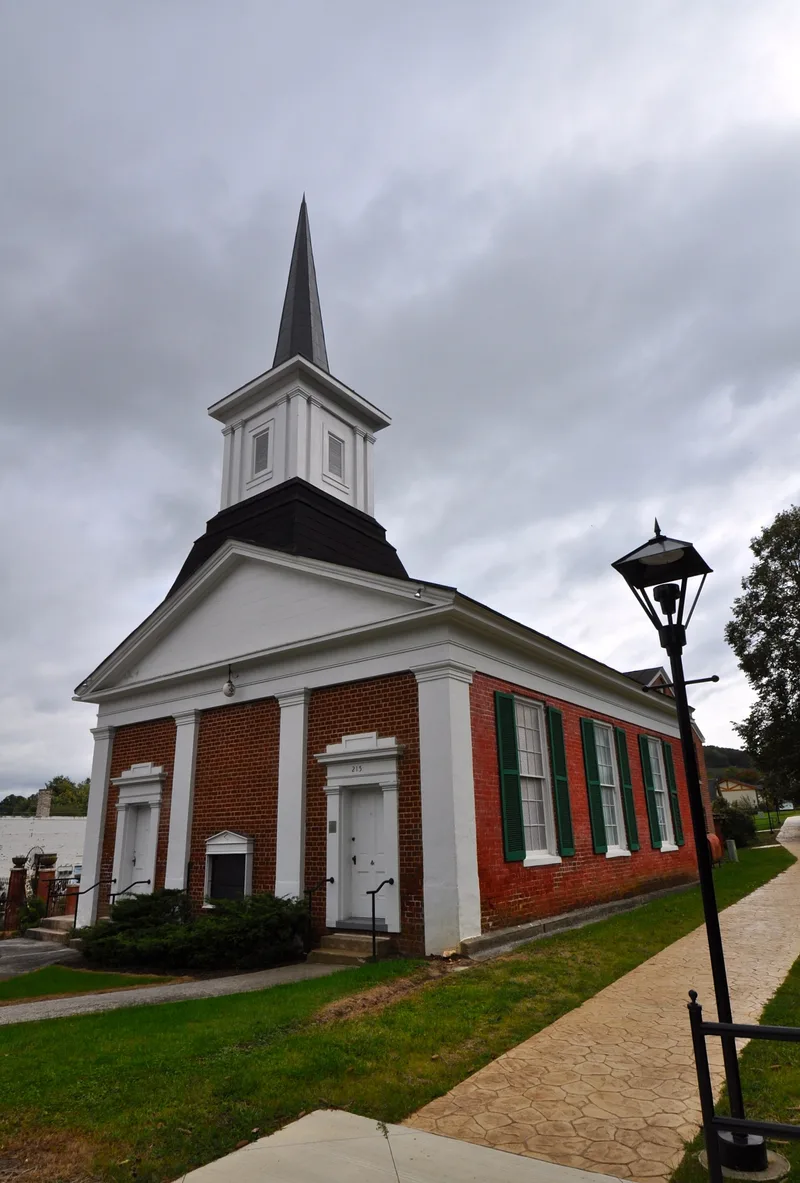
Built in 1850, this small brick church in the county seat of Floyd, Virginia, is a modest but carefully detailed example of Greek Revival design. Builder Henry Dillon, an Irish immigrant trained in Charleston, drew on plates from Asher Benjamin's 1830 pattern book The Practical House Carpenter. The gable-end facade is laid in Flemish bond, with four stuccoed Doric pilasters dividing it into three bays and two frontispiece doorways flanking a blank central panel. A low steeple with a square belfry and octagonal spire crowns the roof. Inside is a single room with a gallery across the north end and a Doric tabernacle on the south wall. A brick Sunday School ell was added in 1956. The church is believed to be the oldest surviving public building in Floyd County and reflects the spread of Presbyterianism in southwest Virginia. The congregation used it continuously until October 1974, when it relocated and the building became vacant.
Significance in brief: The church is a well-crafted example of provincial Greek Revival building, with details taken from Asher Benjamin's pattern book The Practical House Carpenter (1830). It is believed to be the oldest surviving public building in Floyd County and is an important architectural element in the townscape of Floyd Court House. It also reflects the growth of Presbyterianism in southwest Virginia in the early nineteenth century.
Machine-generated summary. This summary was generated by a language model from the official nomination document and has not been reviewed line by line by an editor. It may contain errors. Check the source document before relying on any detail. Source: nomination document (PDF) · National Archives catalog entry. NRHP reference 76002105, listed May 17, 1976. Summary generated October 2026 (model claude-sonnet-5-5, prompt v1.0-2026-10-29, confidence high).
Key facts
| Address | U.S. 221, Floyd |
|---|---|
| County | Floyd County |
| Listed | May 17, 1976 |
| Reference number | 76002105 |
| Resource type | Building |
| Period of significance | 1850 |
| Architect / builder | Henry Dillon |
| Architectural style | Greek Revival (vernacular/provincial) |
| Areas of significance | Architecture, Religion |
| Level of significance | State |
| Status (as stated in the nomination) | Abandoned by its congregation in October 1974 and listed as vacant; its future was uncertain, with local citizens seeking a new use. |
| Acreage | 0.9 |
| Within district | Floyd Historic District |
| Coordinates | 36.91119, -80.31804 (NPS GIS) |
What listing means for this property
Religious properties are listed for their architectural or historical significance, not their religious use. Listing is honorary and does not restrict the congregation's use of the building. The federal rehabilitation credit is generally unavailable unless part of the building is income-producing; some state programmes and preservation grants do cover religious buildings. Federal funding or permits trigger Section 106 review.
Noted as vacant in the nomination. Nomination documents can be decades old; current status may differ. If you are considering buying an empty listed property, read the due-diligence checklist.
General information, not legal or tax advice. Rules change; confirm with your State Historic Preservation Office or a qualified adviser.
Sources and further reading
- National Park Service, National Register of Historic Places database (snapshot May 2026), reference 76002105.
- Nomination form (PDF, National Archives) — catalog entry
- Wikipedia article (used for cross-checking only; text not reproduced here)
- Wikidata Q5462513
- This listing as JSON
Last updated October 2026. Found an error? See the editorial policy for how to report it.