Delaplane Historic District
Also known as: 030-0002

Why it's listed
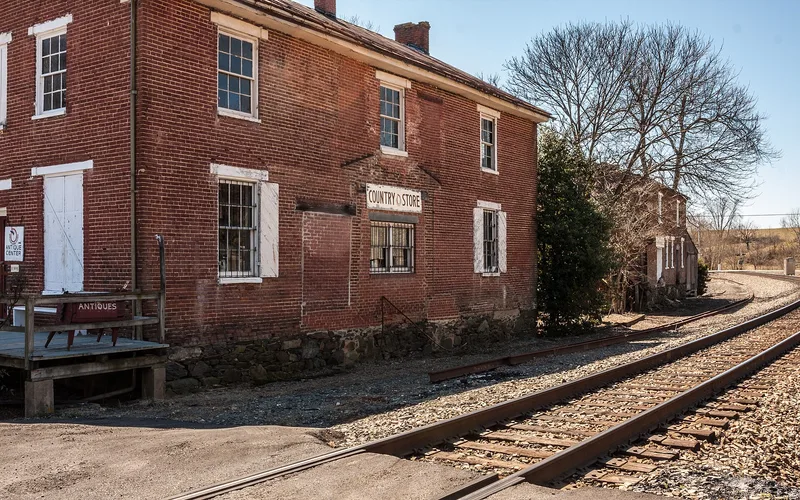
Delaplane is a small rural village in northern Fauquier County, Virginia, that began as Piedmont Station when the Manassas Gap Railroad reached the site in 1852. The historic district covers about 19 acres and includes two nearly identical brick buildings beside the tracks that served as stores, depots and warehouses, along with a Late Greek Revival and Italianate brick dwelling, a mill, a cattle scale house, commercial buildings, I-houses, a former church and a cemetery. Its importance rests on both architecture and history. The 1852 brick buildings are rare surviving antebellum rail-related structures in Virginia. In July 1861, troops under Stonewall Jackson boarded trains here for the First Battle of Manassas, an early large-scale military use of railroads. Very little modern construction has occurred in the village center, so the setting still resembles early photographs. Freight trains continue to pass through, and the post office remains in operation.
Significance in brief: The district is significant under Criteria A and C at the state level. It holds two of the very few surviving antebellum brick rail-related buildings in Virginia. It was also the site of the first use of railroads to move a large number of troops to battle, in July 1861 before First Manassas. It retains a highly intact collection of mid-19th to mid-20th century buildings.
Machine-generated summary. This summary was generated by a language model from the official nomination document and has not been reviewed line by line by an editor. It may contain errors. Check the source document before relying on any detail. Source: nomination document (PDF) · National Archives catalog entry. NRHP reference 04000050, listed February 11, 2004. Summary generated October 2026 (model claude-sonnet-5-5, prompt v1.0-2026-10-29, confidence high).
Key facts
| Address | Area including parts of Delaplane Grade Rd. and Rokeby Rd., Delaplane |
|---|---|
| County | Fauquier County |
| Listed | February 11, 2004 |
| Reference number | 04000050 |
| Resource type | District |
| Period of significance | 1852-1953 |
| Architectural style | Greek Revival, Italianate, Other: I-house |
| Criteria |
|
| Areas of significance | Architecture, Transportation, Military |
| Level of significance | State |
| Status (as stated in the nomination) | The railroad still carries freight, the post office operates in a former store, and an antique store occupies the 1852 brick buildings. The cattle scale house and the mill are vacant, and the former church is being converted into a dwelling. |
| Acreage | 19 |
| Within district | Crooked Run Valley Rural Historic District |
| Coordinates | 38.91682, -77.91968 (NPS GIS) |
What listing means for this property
This is a historic district. Buildings within its boundary are either contributing (they add to the district's significance) or non-contributing. Owners of contributing income-producing buildings can claim the 20% federal rehabilitation tax credit; homeowners should look at state credits. National Register districts impose no design review by themselves; a local historic district ordinance, if one exists, does (the difference explained).
General information, not legal or tax advice. Rules change; confirm with your State Historic Preservation Office or a qualified adviser.
Sources and further reading
- National Park Service, National Register of Historic Places database (snapshot May 2026), reference 04000050.
- Nomination form (PDF, National Archives) — catalog entry
- Wikipedia article (used for cross-checking only; text not reproduced here)
- Wikidata Q14712232
- This listing as JSON
Last updated October 2026. Found an error? See the editorial policy for how to report it.