Greensville County Training School
Also known as: Greensville County Learning Center; Dhr# 109-5001

Why it's listed
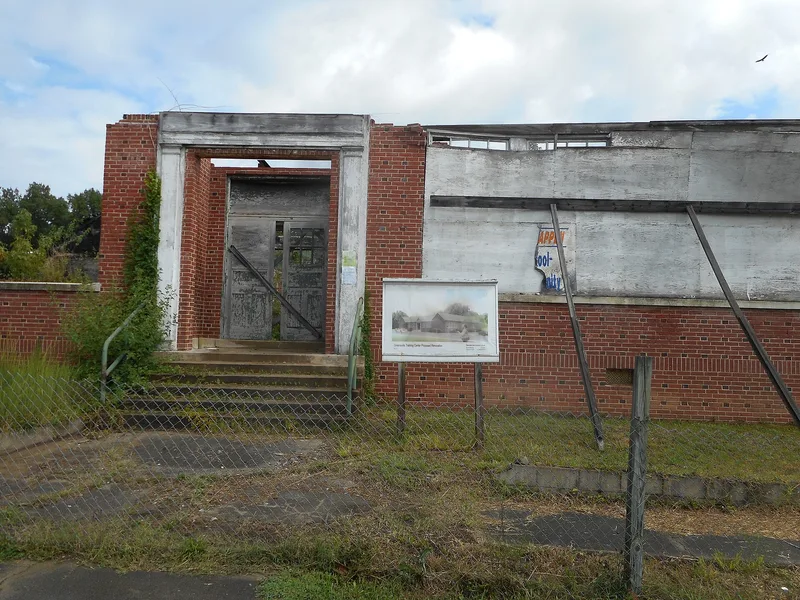
Built in 1929 at 105 Ruffin Street in Emporia, this brick school served African American students in Greensville County. It is a one-story, U-shaped building with a standing seam metal roof, Flemish bond brickwork, brick quoins at the front corners, and a recessed entrance with Colonial Revival pilasters. Its plan follows a six-teacher design, and funding came from the Rosenwald Fund ($1,700), the African American community ($1,000) and public money ($12,419). Only fifteen six-teacher Rosenwald schools were built in Virginia. The school gained a four-year accredited curriculum in 1933 and added classrooms in 1934. It also hosted NAACP meetings, a 4-H club, theater productions and sports. A new high school opened in 1954, and the building closed after desegregation in the 1960s, then served for storage. Neglect and storms have left it unstable and vacant, though its form, plan and brickwork remain visible.
Significance in brief: The school is nominated under Criterion A for its long association with African American education in Greensville County and for its link to philanthropist Julius Rosenwald. It was one of only fifteen six-teacher Rosenwald schools built in Virginia and one of the largest. The site also served as a community center for African American residents for decades.
Machine-generated summary. This summary was generated by a language model from the official nomination document and has not been reviewed line by line by an editor. It may contain errors. Check the source document before relying on any detail. Source: nomination document (PDF) · National Archives catalog entry. NRHP reference 06000122, listed March 8, 2006. Summary generated October 2026 (model claude-sonnet-5-5, prompt v1.0-2026-10-29, confidence high).
Key facts
| Address | 105 Ruffin St., Emporia (Independent City) |
|---|---|
| County | Emporia |
| Listed | March 8, 2006 |
| Reference number | 06000122 |
| Resource type | Building |
| Period of significance | 1929-1955 |
| Architect / builder | Unknown |
| Architectural style | Early 20th Century American Movements |
| Criteria |
|
| Areas of significance | Education, Black |
| Level of significance | Local |
| Status (as stated in the nomination) | Vacant and in poor condition: windows are boarded up, the roof has fallen in and partly destroyed the rear of the east wing, and the walls have buckled. |
| Acreage | 5.5 |
| Coordinates | 36.69924, -77.53556 (NPS GIS) |
What listing means for this property
For a publicly owned building or structure, listing mainly matters when federal funds, permits or licences are involved: projects then go through Section 106 review so effects on the property are considered. Listing also strengthens applications for preservation grants and, for leased income-producing uses, can enable the federal rehabilitation tax credit.
Noted as vacant in the nomination. Nomination documents can be decades old; current status may differ. If you are considering buying an empty listed property, read the due-diligence checklist.
General information, not legal or tax advice. Rules change; confirm with your State Historic Preservation Office or a qualified adviser.
Sources and further reading
- National Park Service, National Register of Historic Places database (snapshot May 2026), reference 06000122.
- Nomination form (PDF, National Archives) — catalog entry
- Wikipedia article (used for cross-checking only; text not reproduced here)
- Wikidata Q15222127
- This listing as JSON
Last updated October 2026. Found an error? See the editorial policy for how to report it.