Covington Historic District
Also known as: DHR File No. 107-25

Why it's listed
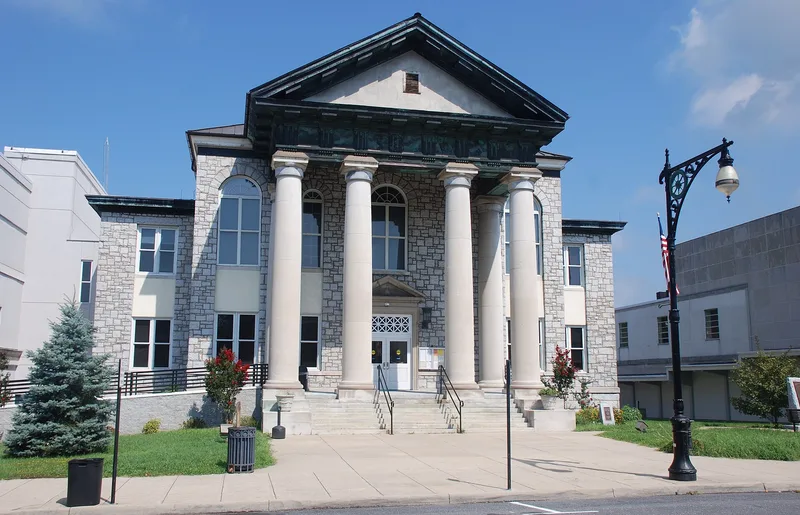
Covington's historic district preserves the downtown and original town grid of a Virginia county seat laid out in 1818 on a terrace beside the Jackson River. About forty acres, it holds log and brick houses from the 1810s to 1830s with similar Federal-style interiors, later Victorian and Colonial Revival homes, and a dense Main Street of brick commercial buildings. Arrival of the Virginia Central Railroad in 1867, and the 1890 consolidation of the Chesapeake and Ohio line, brought industry and rapid growth. Banks, a 1910 limestone courthouse, a 1914 post office, churches, a school, the Hotel Collins and the Hippodrome Theater reflect that prosperity. A secondary commercial area grew along Maple Avenue near the railroad, where a Mission-style passenger station of about 1914 and an older freight depot remain. The district was listed for its commercial and transportation history and its architecture, covering the years from 1818 to about 1940.
Significance in brief: The district is significant under Criterion A for the commercial development of Covington and for its rail transportation history tied to the Chesapeake and Ohio Railway. It is significant under Criterion C for its range of architecture, from Federal-style log and brick houses to Neoclassical banks and Mission-style railroad station.
Machine-generated summary. This summary was generated by a language model from the official nomination document and has not been reviewed line by line by an editor. It may contain errors. Check the source document before relying on any detail. Source: nomination document (PDF) · National Archives catalog entry. NRHP reference 91000099, listed February 21, 1991. Summary generated October 2026 (model claude-sonnet-5-5, prompt v1.0-2026-10-29, confidence medium).
Key facts
| Address | Roughly bounded by the Jackson R., Monroe Ave., CSX RR tracks, and Maple Ave., Covington (Independent City) |
|---|---|
| County | Covington |
| Listed | February 21, 1991 |
| Reference number | 91000099 |
| Resource type | District |
| Period of significance | 1818 to the eve of World War II (about 1818-1940) |
| Architect / builder | Oscar Wenderoth (Covington Post Office, 1914); Charles M. Robinson (courthouse, 1910); Phoenix Iron Company of Philadelphia (Hawthorne Street Bridge) |
| Architectural style | Federal, Italianate, Queen Anne, Colonial Revival, Classical Revival, Tudor Revival, Late Gothic Revival, Mission/Spanish Colonial Revival, Bungalow/Craftsman, Moderne, Art Deco, I House, Foursquare |
| Criteria |
|
| Areas of significance | Commerce, Transportation, Architecture |
| Level of significance | State |
| Status (as stated in the nomination) | Current uses include commercial, residential, government, religious, educational, museum and theater functions. |
| Acreage | 40 |
| Coordinates | 37.78932, -79.99526 (NPS GIS) |
What listing means for this property
This is a historic district. Buildings within its boundary are either contributing (they add to the district's significance) or non-contributing. Owners of contributing income-producing buildings can claim the 20% federal rehabilitation tax credit; homeowners should look at state credits. National Register districts impose no design review by themselves; a local historic district ordinance, if one exists, does (the difference explained).
General information, not legal or tax advice. Rules change; confirm with your State Historic Preservation Office or a qualified adviser.
Sources and further reading
- National Park Service, National Register of Historic Places database (snapshot May 2026), reference 91000099.
- Nomination form (PDF, National Archives) — catalog entry
- Wikipedia article (used for cross-checking only; text not reproduced here)
- Wikidata Q15211879
- This listing as JSON
Last updated October 2026. Found an error? See the editorial policy for how to report it.