Bellona Arsenal

Why it's listed
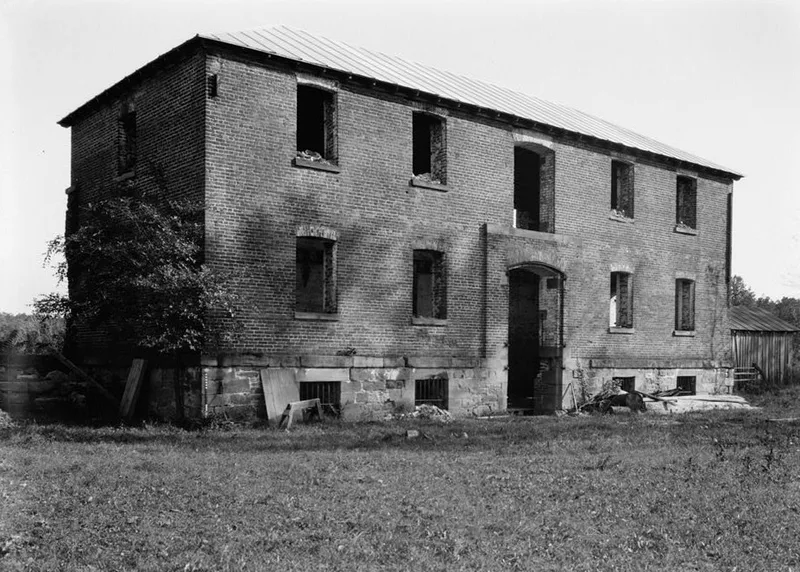
Bellona Arsenal is a complex of brick workshops and ruins near Midlothian, Virginia, left from a federal arsenal built in the 1810s. The quadrangle once held eight stone-walled buildings, including a three-story main arsenal, officers' quarters, four workshops and a barracks, with a thick-walled powder magazine outside to the west. Most were torn down about 1872. Three two-story brick workshops with hipped roofs and segmental arched openings remain, along with the roofless magazine and the ruins of Major John Clarke's foundry, which he established in 1814. The foundry supplied government cannon through the antebellum years and served the Confederacy, and the arsenal stored Clarke's guns from 1817. The government declared the arsenal surplus in 1837, and it was sold in 1856 and again in 1877. The workshops were renovated as a residence beginning in 1942. The listing recognizes the site's industrial and military history and its setting above the James River valley.
Significance in brief: The arsenal and its neighboring foundry were a major source of government ordnance before the Civil War and served the Confederacy during it. Together with Tredegar, Bellona gave Virginia two of the five plants casting heavy cannon on the eve of Secession. The surviving workshops and ruins, set above the James River valley, are also noted for their architecture and site.
Machine-generated summary. This summary was generated by a language model from the official nomination document and has not been reviewed line by line by an editor. It may contain errors. Check the source document before relying on any detail. Source: nomination document (PDF) · National Archives catalog entry. NRHP reference 71000975, listed May 6, 1971. Summary generated October 2026 (model claude-sonnet-5-5, prompt v1.0-2026-10-29, confidence medium).
Key facts
| Address | Off VA 673, NW of jct. with Rte. 147, Midlothian |
|---|---|
| County | Chesterfield County |
| Listed | May 6, 1971 |
| Reference number | 71000975 |
| Resource type | District |
| Period of significance | 19th Century |
| Areas of significance | Architecture, Social History |
| Level of significance | State |
| Status (as stated in the nomination) | Three surviving workshops, empty shells before renovation began in 1942, have been converted into a private residence; the powder magazine survives as a roofless ruin. Condition is marked good and ruins. |
| Acreage | 100 |
| Coordinates | 37.55385, -77.61694 (NPS GIS) |
What listing means for this property
This is a historic district. Buildings within its boundary are either contributing (they add to the district's significance) or non-contributing. Owners of contributing income-producing buildings can claim the 20% federal rehabilitation tax credit; homeowners should look at state credits. National Register districts impose no design review by themselves; a local historic district ordinance, if one exists, does (the difference explained).
General information, not legal or tax advice. Rules change; confirm with your State Historic Preservation Office or a qualified adviser.
Sources and further reading
- National Park Service, National Register of Historic Places database (snapshot May 2026), reference 71000975.
- Nomination form (PDF, National Archives) — catalog entry
- Wikipedia article (used for cross-checking only; text not reproduced here)
- Wikidata Q4884112
- This listing as JSON
Last updated October 2026. Found an error? See the editorial policy for how to report it.