Liendo Plantation

Why it's listed
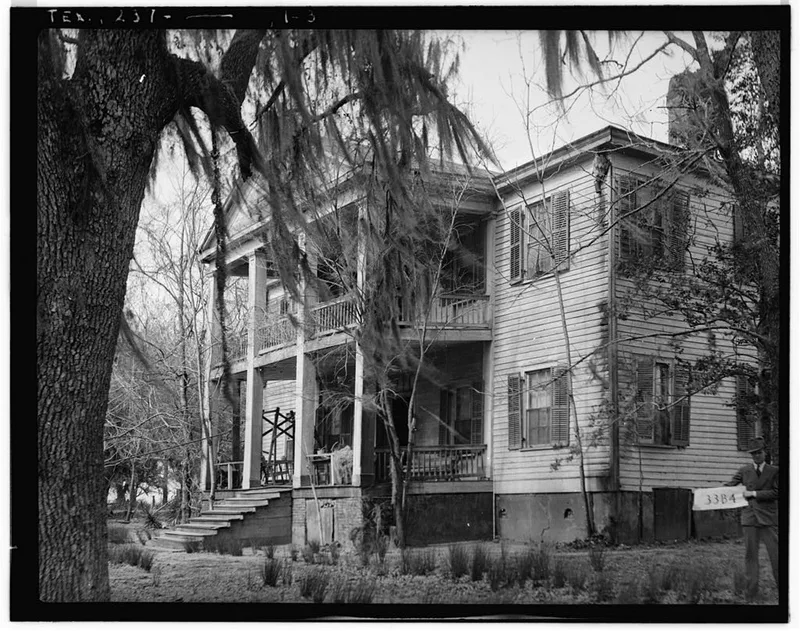
Liendo Plantation is a sixteen-room, two-story Greek Revival house near Hempstead in Waller County, Texas. Leonard W. Groce completed it in 1853 on a raised brick basement, using slave labor and bricks made from Brazos River clay. A two-story double-pedimented gallery with four square columns marks the south front, and a lunette in the pediment bears a star and the date 1853. Inside, the drawing room ceiling is hand painted with roses and morning glories. The plantation, established in 1830, operated with about three hundred slaves and hosted prominent travelers between Houston-Galveston and Austin. During the Civil War it held Camp Groce, which later became a prisoner of war camp, and in 1865 General Custer's command camped there. From 1873 the property was the home of Dr. Edmund Montgomery and sculptor Elizabet Ney, who made statues of Stephen F. Austin and Sam Houston. Both are buried on the grounds. The house is in excellent condition after extensive restoration.
Significance in brief: The house is a well-preserved example of late Greek Revival architecture on one of the best-known Texas plantations. It was also the home from 1873 until the early twentieth century of Dr. Edmund Montgomery, a scientist and philosopher, and the sculptor Elizabet Ney. During the Civil War the grounds served as Camp Groce, later a prisoner of war camp.
Machine-generated summary. This summary was generated by a language model from the official nomination document and has not been reviewed line by line by an editor. It may contain errors. Check the source document before relying on any detail. Source: nomination document (PDF) · National Archives catalog entry. NRHP reference 71000970, listed June 21, 1971. Summary generated October 2026 (model claude-sonnet-5-5, prompt v1.0-2026-10-29, confidence high).
Key facts
| Address | 2 mi. NE of Hempstead off FM 1488, Hempstead |
|---|---|
| County | Waller County |
| Listed | June 21, 1971 |
| Reference number | 71000970 |
| Resource type | Building |
| Period of significance | 19th Century (specific date 1853) |
| Architect / builder | Leonard W. Groce (builder, with slave labor) |
| Architectural style | Late Greek Revival |
| Areas of significance | Agriculture, Art, Science, Architecture |
| Level of significance | State |
| Status (as stated in the nomination) | Excellent condition, unaltered and on its original site; extensively restored by the present owners and used as a private residence. |
| Acreage | 9 |
| Coordinates | 30.09660, -96.02996 (NPS GIS) |
What listing means for this property
National Register listing is honorary for a privately owned home: it does not by itself restrict what an owner may do with their own money, and it does not require public access. Restrictions come from local landmark or historic-district ordinances, which are separate (how they differ).
Owner-occupied houses are not eligible for the 20% federal rehabilitation tax credit, which applies to income-producing buildings, but many states offer credits for homeowners. Listing also opens the door to preservation easements and to buying a plaque. Start with what listing means for homeowners, renovating a listed house and selling one.
General information, not legal or tax advice. Rules change; confirm with your State Historic Preservation Office or a qualified adviser.
Sources and further reading
- National Park Service, National Register of Historic Places database (snapshot May 2026), reference 71000970.
- Nomination form (PDF, National Archives) — catalog entry
- Wikipedia article (used for cross-checking only; text not reproduced here)
- Wikidata Q6544183
- This listing as JSON
Last updated October 2026. Found an error? See the editorial policy for how to report it.