Caldwell Hall
Also known as: 62

Why it's listed
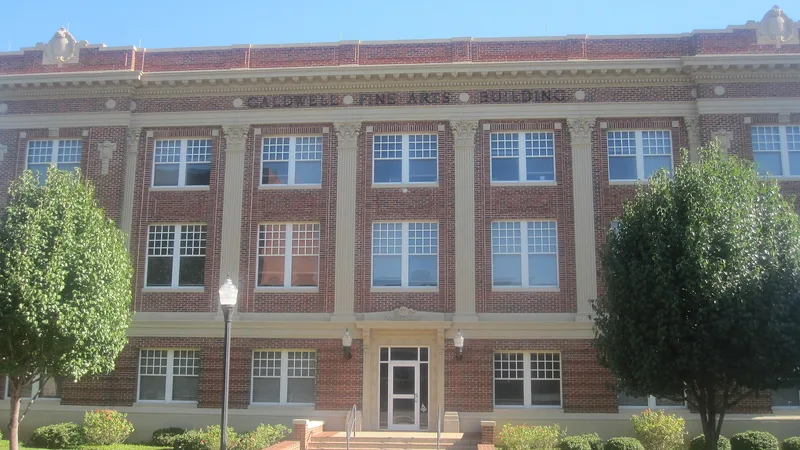
Caldwell Hall is a three-story brick building on the Hardin-Simmons University campus in Abilene, Texas, built in 1922. Its load-bearing masonry walls rest on a concrete foundation and are topped by a parapet hiding a flat roof. The south facade is symmetrical, with a rusticated first story, six fluted Corinthian pilasters, pedimented entrances, and a cornice with modillions and dentils. Funding came from Clifton M. Caldwell, a Breckenridge attorney who profited from the 1919 oil boom and gave $100,000 for a fine arts building; he also owned a music store. The hall reflects the generosity of Abilene's wealthiest citizens toward education during the city's rapid growth in the 1920s. Alterations include replacement of the original wood windows with aluminum ones, a small one-story rear addition, and interior updates in 1962. Even so, it remains the best preserved historic building on the campus and a strong local example of Classical Revival design.
Significance in brief: It is significant for its contribution to educational efforts in Abilene and as an example of philanthropy by the city's wealthy citizens, since Clifton M. Caldwell funded its construction. It is also an outstanding local example of Classical Revival architecture. It is described as the least altered and best preserved historic building on the campus.
Machine-generated summary. This summary was generated by a language model from the official nomination document and has not been reviewed line by line by an editor. It may contain errors. Check the source document before relying on any detail. Source: nomination document (PDF) · National Archives catalog entry. NRHP reference 92000206, listed March 23, 1992. Summary generated October 2026 (model claude-sonnet-5-5, prompt v1.0-2026-10-29, confidence high).
Key facts
| Address | Intracampus Dr., Hardin--Simmons University, Abilene |
|---|---|
| County | Taylor County |
| Listed | March 23, 1992 |
| Reference number | 92000206 |
| Resource type | Building |
| Period of significance | 1922-1939 |
| Architectural style | Classical Revival |
| Criteria |
|
| Areas of significance | Education, Architecture, Social History |
| Level of significance | Local |
| Status (as stated in the nomination) | Described as in good condition and retaining integrity; still used for education as a college building. |
| Acreage | 0.9 |
| Coordinates | 32.47768, -99.73553 (NPS GIS) |
What listing means for this property
National Register listing is honorary for a privately owned home: it does not by itself restrict what an owner may do with their own money, and it does not require public access. Restrictions come from local landmark or historic-district ordinances, which are separate (how they differ).
Owner-occupied houses are not eligible for the 20% federal rehabilitation tax credit, which applies to income-producing buildings, but many states offer credits for homeowners. Listing also opens the door to preservation easements and to buying a plaque. Start with what listing means for homeowners, renovating a listed house and selling one.
General information, not legal or tax advice. Rules change; confirm with your State Historic Preservation Office or a qualified adviser.
Sources and further reading
- National Park Service, National Register of Historic Places database (snapshot May 2026), reference 92000206.
- Nomination form (PDF, National Archives) — catalog entry
- Wikidata Q110001317
- This listing as JSON
Last updated October 2026. Found an error? See the editorial policy for how to report it.