Abilene Street Railway Company Barn
Also known as: 1048

Why it's listed
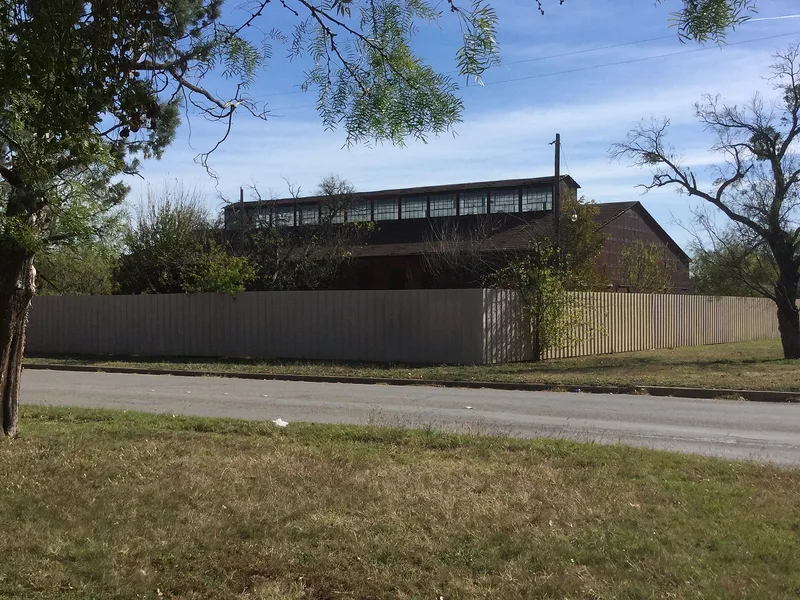
Built about 1910 at 1037 Clinton Street, this metal-clad barn in Abilene, Texas, once sheltered the city's streetcars. It is a rectangular, open-plan industrial building with a gable roof and a gable clerestory along the ridge. Square metal wall panels form a rhythmic pattern, and several are hinged to provide ventilation. Bi-parting doors hung on overhead metal tracks allowed streetcars to pass in and out. The Abilene Street Railway Company was organized by 1908 by officials of the Abilene Light and Water Company, which owned a power plant that made electric streetcars possible. The first streetcar ran that November, and the system was a source of civic pride for a city of its size. Troubled by difficulties throughout its life, it shut down in 1931, and its tracks were removed or paved over. The barn, used for storage from about 1910 to 1931, is now the only visible reminder of that system. It is vacant but in good condition and retains its integrity.
Significance in brief: It is nominated under Criterion A in the area of Transportation for its association with Abilene's local streetcar system. It is the only visible reminder of the long-abandoned streetcar network, which ran from about 1908 until 1931. It also fits the context of the railroad's role in making Abilene a wholesale and distribution center in West Texas.
Machine-generated summary. This summary was generated by a language model from the official nomination document and has not been reviewed line by line by an editor. It may contain errors. Check the source document before relying on any detail. Source: nomination document (PDF) · National Archives catalog entry. NRHP reference 92000205, listed March 23, 1992. Summary generated October 2026 (model claude-sonnet-5-5, prompt v1.0-2026-10-29, confidence medium).
Key facts
| Address | 1037 Clinton St., Abilene |
|---|---|
| County | Taylor County |
| Listed | March 23, 1992 |
| Reference number | 92000205 |
| Resource type | Building |
| Period of significance | c. 1910-1931 |
| Architectural style | Other: industrial storage: warehouse |
| Criteria |
|
| Areas of significance | Transportation |
| Level of significance | Local |
| Status (as stated in the nomination) | Vacant and not in use, but in good condition and retaining its integrity. |
| Acreage | 0.9 |
| Coordinates | 32.46140, -99.74284 (NPS GIS) |
What listing means for this property
For an income-producing building, listing (individually or as a contributing building in a district) is the gateway to the 20% federal rehabilitation tax credit on qualified rehabilitation costs, often stackable with state credits. Work claiming the credit must follow the Secretary of the Interior's Standards and be approved in advance.
Listing does not restrict a private owner acting without federal money or permits; where federal funding or licensing is involved, Section 106 review applies.
Noted as vacant in the nomination. Nomination documents can be decades old; current status may differ. If you are considering buying an empty listed property, read the due-diligence checklist.
General information, not legal or tax advice. Rules change; confirm with your State Historic Preservation Office or a qualified adviser.
Sources and further reading
- National Park Service, National Register of Historic Places database (snapshot May 2026), reference 92000205.
- Nomination form (PDF, National Archives) — catalog entry
- Wikidata Q110001315
- This listing as JSON
Last updated October 2026. Found an error? See the editorial policy for how to report it.