Leuda-May Historic District

Why it's listed
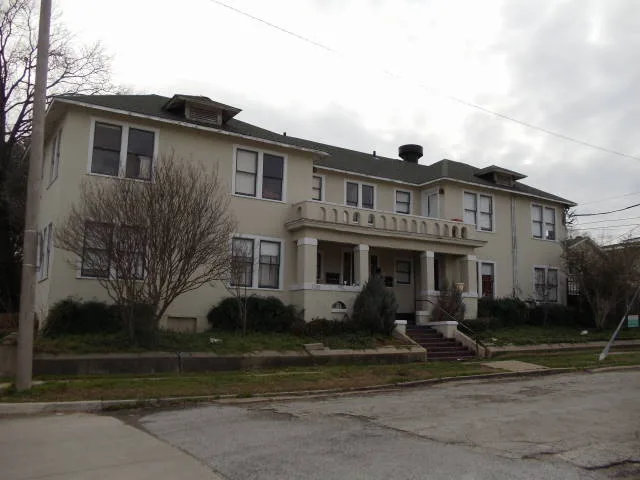
Five early twentieth-century residential buildings make up this small district just south of downtown Fort Worth, on the northern end of a subdivided city block facing West Leuda and May streets. Three are two-story apartment buildings and two are garage/apartments, all built between about 1923 and 1936. The apartment designs are vernacular: 301 W. Leuda interprets Italian Renaissance Revival, Roseland Apartments at 311 W. Leuda shows Prairie School influence, and 805 May Street blends Colonial Revival and Bungalow features. The garage/apartments have no distinctive style. The block was once the grounds of a large late nineteenth-century house, and 301 W. Leuda, built in 1936 by Pirl Steagall, incorporated salvaged material believed to come from it, which makes each of its apartments distinct. In 1922 the landowners subdivided the block into lots, and their deeds required apartments or dwellings of minimum cost. Much of the surrounding neighborhood has lost historic buildings, but these rehabilitated apartments retain a high degree of integrity and remain in residential use.
Significance in brief: The buildings are intact examples of 1920s-30s apartment construction in Fort Worth's South Side, in vernacular Italian Renaissance Revival, Prairie School and Colonial Revival/Bungalow designs. They were built on a subdivided block that once held a large late 19th-century house, and two used salvaged material from it. The nomination treats the group as locally significant.
Machine-generated summary. This summary was generated by a language model from the official nomination document and has not been reviewed line by line by an editor. It may contain errors. Check the source document before relying on any detail. Source: nomination document (PDF) · National Archives catalog entry. NRHP reference 05000240, listed March 30, 2005. Summary generated October 2026 (model claude-sonnet-5-5, prompt v1.0-2026-10-29, confidence medium).
Key facts
| Address | 301-311 W. Leuda and 805-807 May Sts., Fort Worth |
|---|---|
| County | Tarrant County |
| Listed | March 30, 2005 |
| Reference number | 05000240 |
| Resource type | District |
| Architect / builder | Pirl Steagall (aka R.E. Steagall) built 301 W. Leuda Street in 1936; A.C. Barber is named as a builder/lienholder for other work in the subdivision. |
| Architectural style | Late 19th and 20th Century Revivals: Colonial Revival, Renaissance Revival; Late 19th and Early 20th Century American Movements: Prairie School; no style |
| Areas of significance | Community Planning and Development, Architecture |
| Level of significance | Local |
| Status (as stated in the nomination) | Recently rehabilitated apartment buildings in continued residential use; they retain a high degree of integrity. |
| Acreage | 0.9 |
| Coordinates | 32.73726, -97.32919 (NPS GIS) |
What listing means for this property
This is a historic district. Buildings within its boundary are either contributing (they add to the district's significance) or non-contributing. Owners of contributing income-producing buildings can claim the 20% federal rehabilitation tax credit; homeowners should look at state credits. National Register districts impose no design review by themselves; a local historic district ordinance, if one exists, does (the difference explained).
General information, not legal or tax advice. Rules change; confirm with your State Historic Preservation Office or a qualified adviser.
Sources and further reading
- National Park Service, National Register of Historic Places database (snapshot May 2026), reference 05000240.
- Nomination form (PDF, National Archives) — catalog entry
- Wikipedia article (used for cross-checking only; text not reproduced here)
- Wikidata Q6534473
- This listing as JSON
Last updated October 2026. Found an error? See the editorial policy for how to report it.