Ginocchio Historic District

Why it's listed
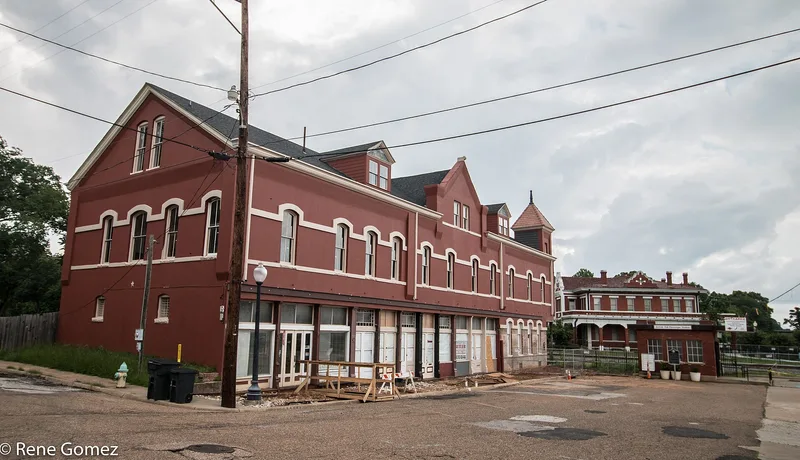
Beside the Texas and Pacific depot in Marshall, Texas, this 25-acre district gathers the buildings and sites tied to the town's railroad era. Its centerpiece is the Ginocchio Hotel, a three-story brick building designed by C. G. Lancaster and built between 1893 and 1896 for restaurateur Charles A. Ginocchio. It is known for its thick walls and extensive curly pine woodwork milled in the railway shops. Nearby are Ginocchio's 1886 brick house and several Victorian residences, including the Whaley, Allen, Mitchell, Crowall, Meyers and Patillo houses. The district also takes in the 1908 Mission Revival passenger depot, freight station, railway shops, steel water towers, Bolivar Street viaducts and the Marshall cemetery, the city's oldest, where early Texas leaders are buried. Marshall became the eastern terminus of the Texas and Pacific in 1873, and the district was listed as a surviving link to that heritage while urban renewal threatened the area.
Significance in brief: The district is argued to be significant for its architecture and its link to transportation, as a tangible reminder of Marshall's railroad heritage. It centers on C. A. Ginocchio's hotel and house, built to serve Texas and Pacific passengers, along with the depot, shops and the city's oldest cemetery. The nomination notes it was threatened by urban renewal.
Machine-generated summary. This summary was generated by a language model from the official nomination document and has not been reviewed line by line by an editor. It may contain errors. Check the source document before relying on any detail. Source: nomination document (PDF) · National Archives catalog entry. NRHP reference 74002076, listed December 31, 1974. Summary generated October 2026 (model claude-sonnet-5-5, prompt v1.0-2026-10-29, confidence medium).
Key facts
| Address | Bounded by Grand Ave., and N. Franklin, Willow, and Lake Sts., Marshall |
|---|---|
| County | Harrison County |
| Listed | December 31, 1974 |
| Reference number | 74002076 |
| Resource type | District |
| Architect / builder | C. G. Lancaster (designed the Ginocchio Hotel in 1896 and the Ginocchio house in 1886; also built the Meyers House) |
| Architectural style | Victorian houses, Queen Anne (vernacular), and Mission Revival (1908 depot) |
| Areas of significance | Transportation, Architecture |
| Level of significance | Local |
| Status (as stated in the nomination) | Hotel restored and reopened as a restaurant in 1968; depot in use as an Amtrak passenger station; the district was described as threatened by urban renewal. |
| Acreage | 25 |
| Coordinates | 32.55146, -94.36611 (NPS GIS) |
What listing means for this property
This is a historic district. Buildings within its boundary are either contributing (they add to the district's significance) or non-contributing. Owners of contributing income-producing buildings can claim the 20% federal rehabilitation tax credit; homeowners should look at state credits. National Register districts impose no design review by themselves; a local historic district ordinance, if one exists, does (the difference explained).
General information, not legal or tax advice. Rules change; confirm with your State Historic Preservation Office or a qualified adviser.
Sources and further reading
- National Park Service, National Register of Historic Places database (snapshot May 2026), reference 74002076.
- Nomination form (PDF, National Archives) — catalog entry
- Wikipedia article (used for cross-checking only; text not reproduced here)
- Wikidata Q5563250
- This listing as JSON
Last updated October 2026. Found an error? See the editorial policy for how to report it.