Cohn, Arthur B., House
Also known as: Saint Francis Center

Why it's listed
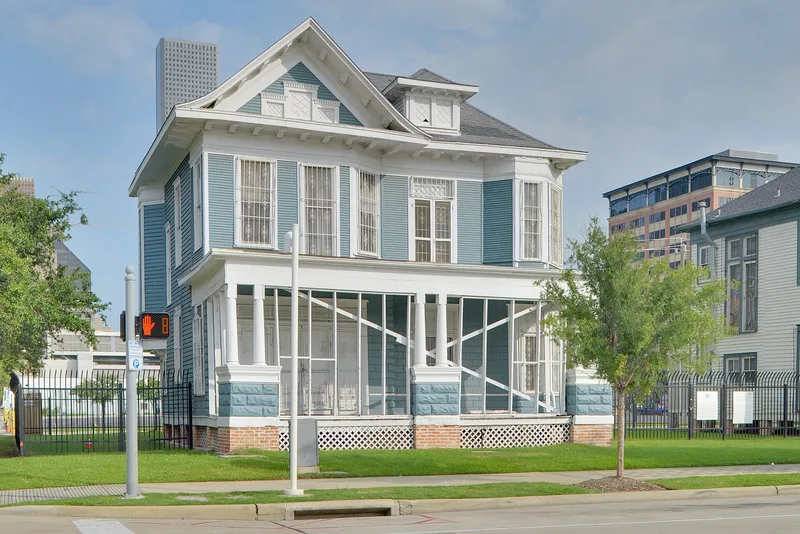
This two-story white frame house at 1711 Rusk Avenue in Houston was built in 1905 for Arthur Benjamin Cohn. Designed in a late Queen Anne style with classical touches, it has a first floor clad in wooden blocks cut to resemble stone, cast-stone piers, wide bracketed eaves, and an irregular pitched roof. The double front doors, side lights and transom carry an intricate cut and beveled glass pattern. A small rear kitchen wing may predate the main house and may relate to an 1860s house built by Winnifred Browne on or near the site. Cohn was William Marsh Rice's Houston bookkeeper, helped establish the Rice Institute, and served as its first business manager. He lived here between 1905 and 1909, and it is the only one of his residences still standing. The house was later divided into rented rooms, then purchased in 1964 by a Catholic charitable group, which refurbished it. The builder and architect are unknown.
Significance in brief: The nomination ties the house to Arthur B. Cohn, the first business manager of Rice University, who lived there during the university's formative years from 1905 to 1912. It is also presented as the last of many turn-of-the-century middle-class houses once in the neighborhood, with fine details such as cast-stone rustication and cut and beveled glass.
Machine-generated summary. This summary was generated by a language model from the official nomination document and has not been reviewed line by line by an editor. It may contain errors. Check the source document before relying on any detail. Source: nomination document (PDF) · National Archives catalog entry. NRHP reference 85002771, listed November 7, 1985. Summary generated October 2026 (model claude-sonnet-5-5, prompt v1.0-2026-10-29, confidence medium).
Key facts
| Address | 1711 Rusk Ave., Houston |
|---|---|
| County | Harris County |
| Listed | November 7, 1985 |
| Reference number | 85002771 |
| Resource type | Building |
| Period of significance | 1900- (specific date 1905) |
| Architectural style | Late Queen Anne with some classical detail |
| Areas of significance | Education, Architecture |
| Level of significance | Local |
| Status (as stated in the nomination) | Occupied and maintained in good condition by its current owners, a religious charitable group; refurbished in 1964. |
| Acreage | 0.9 |
| Coordinates | 29.75463, -95.35719 (NPS GIS) |
What listing means for this property
National Register listing is honorary for a privately owned home: it does not by itself restrict what an owner may do with their own money, and it does not require public access. Restrictions come from local landmark or historic-district ordinances, which are separate (how they differ).
Owner-occupied houses are not eligible for the 20% federal rehabilitation tax credit, which applies to income-producing buildings, but many states offer credits for homeowners. Listing also opens the door to preservation easements and to buying a plaque. Start with what listing means for homeowners, renovating a listed house and selling one.
General information, not legal or tax advice. Rules change; confirm with your State Historic Preservation Office or a qualified adviser.
Sources and further reading
- National Park Service, National Register of Historic Places database (snapshot May 2026), reference 85002771.
- Nomination form (PDF, National Archives) — catalog entry
- Wikipedia article (used for cross-checking only; text not reproduced here)
- Wikidata Q60750979
- This listing as JSON
Last updated October 2026. Found an error? See the editorial policy for how to report it.