Schneider Hotel
Also known as: Pampa Hotel

Why it's listed
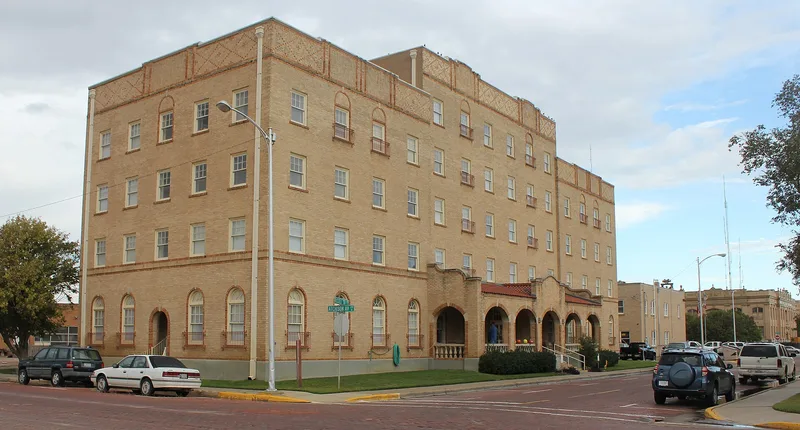
Rising five stories beside the Santa Fe tracks in downtown Pampa, the Schneider Hotel opened in 1927 with more than 100 rooms. Alex Schneider, who had run a smaller frame hotel on the site since 1912, financed construction through a corporation he formed. M.C. Parker designed the rough-textured buff-brick building, which has dark-brick trim, wrought-iron window grilles, and arcaded Mission Revival porches on its east and west faces. Charles H. Sharp was the contractor. The hotel was completed as Gray County's oil boom took off, and Pampa grew from 987 residents in 1920 to 10,470 in 1930. It became a gathering place for oil executives, land men and drillers, and for dances, civic events and traveling entertainers. Business declined after World War II, and by the early 1980s the building stood vacant. It anchors "Million Dollar Row" with the city hall, fire department, Combs-Worley Building and county courthouse, and it remains a recognized local landmark.
Significance in brief: The hotel is one of several downtown buildings marking Pampa's first era of growth during the Panhandle oil boom of the late 1920s, and it anchors the south end of "Million Dollar Row." As one of the largest private ventures in Pampa in the 1920s, it served as the city's social center and an economic hub for the Gray County oil industry. It remains a well-known local landmark.
Machine-generated summary. This summary was generated by a language model from the official nomination document and has not been reviewed line by line by an editor. It may contain errors. Check the source document before relying on any detail. Source: nomination document (PDF) · National Archives catalog entry. NRHP reference 85003215, listed December 19, 1985. Summary generated October 2026 (model claude-sonnet-5-5, prompt v1.0-2026-10-29, confidence high).
Key facts
| Address | 120 S. Russell, Pampa |
|---|---|
| County | Gray County |
| Listed | December 19, 1985 |
| Reference number | 85003215 |
| Resource type | Building |
| Period of significance | 1900- |
| Architect / builder | M.C. Parker, Architect; Charles H. Sharp, Contractor |
| Architectural style | Spanish Colonial Revival influences, with Mission Revival porch |
| Areas of significance | Commerce, Architecture |
| Level of significance | Local |
| Status (as stated in the nomination) | Vacant and unoccupied at the time of nomination; the building was reported in generally good condition, and the owner planned to convert the 102 hotel rooms to apartments for the elderly. |
| Acreage | 0.9 |
| Coordinates | 35.53445, -100.96221 (NPS GIS) |
What listing means for this property
For an income-producing building, listing (individually or as a contributing building in a district) is the gateway to the 20% federal rehabilitation tax credit on qualified rehabilitation costs, often stackable with state credits. Work claiming the credit must follow the Secretary of the Interior's Standards and be approved in advance.
Listing does not restrict a private owner acting without federal money or permits; where federal funding or licensing is involved, Section 106 review applies.
Noted as vacant in the nomination. Nomination documents can be decades old; current status may differ. If you are considering buying an empty listed property, read the due-diligence checklist.
General information, not legal or tax advice. Rules change; confirm with your State Historic Preservation Office or a qualified adviser.
Sources and further reading
- National Park Service, National Register of Historic Places database (snapshot May 2026), reference 85003215.
- Nomination form (PDF, National Archives) — catalog entry
- Wikidata Q107320715
- This listing as JSON
Last updated October 2026. Found an error? See the editorial policy for how to report it.