Strand Historic District, The

Why it's listed
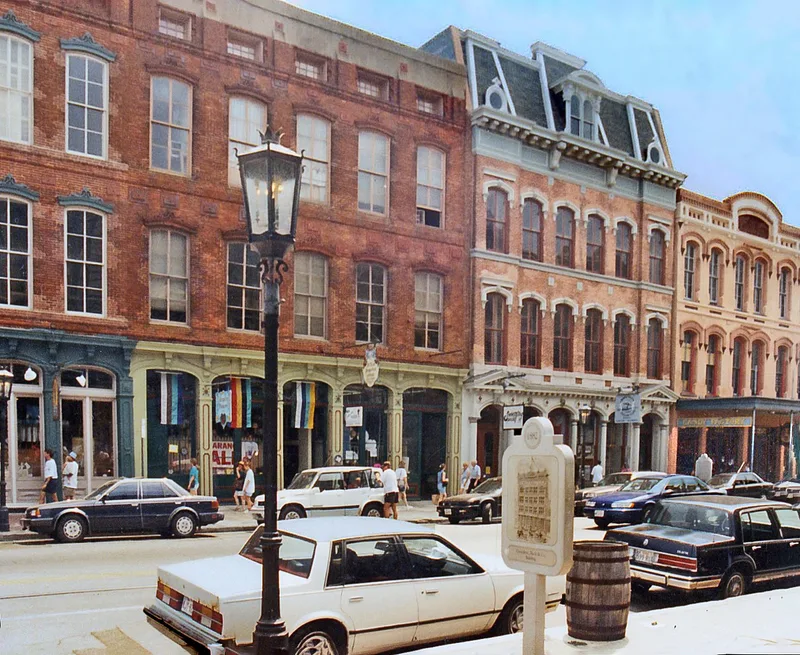
Galveston's Strand district is a group of at least forty-five commercial buildings near the shipping channel, built mainly between the 1850s and 1890s. For decades it was the city's main business street and the base of influential merchants and financiers such as Henry Rosenberg, John Sealy, J. J. Hendley and W. L. Moody. The buildings show popular styles from Greek Revival to Beaux Arts, usually in modest forms, with arcaded ground floors, cast iron fronts and stuccoed or red brick walls. Several were designed by Nicholas J. Clayton. The 1858 Hendley Building took part in the 1863 Battle of Galveston, when a shot was fired from its roof. Fires in the 1870s and the 1900 hurricane removed many cornices and raised the street level. The district was valued as a largely intact record of late nineteenth-century commerce. At the time of the nomination the buildings were run down, several were vacant, and local groups were beginning restoration and reuse.
Significance in brief: The Strand was Galveston's principal commercial area from the 1850s to the early 1900s and housed the businesses of prominent and influential Texas entrepreneurs. The nomination argues that preserving the buildings together keeps a visual record of late 19th-century commercial life and tastes, with styles from Greek Revival to Beaux Arts. Business stagnation after the 1900 hurricane and the rise of the Houston Ship Channel left the buildings largely intact.
Machine-generated summary. This summary was generated by a language model from the official nomination document and has not been reviewed line by line by an editor. It may contain errors. Check the source document before relying on any detail. Source: nomination document (PDF). NRHP reference 70000748, listed January 26, 1970. Summary generated October 2026 (model claude-sonnet-5-5, prompt v1.0-2026-10-29, confidence medium).
Key facts
| Address | Roughly bounded by Ave. A, 20th St., alley between Aves. C and D, and railroad depot, Galveston |
|---|---|
| County | Galveston County |
| Listed | January 26, 1970 |
| Reference number | 70000748 |
| Resource type | District |
| Period of significance | approximately 1850's to 1890's |
| Architect / builder | Nicholas J. Clayton (architect of several buildings, including the Moody Building and the Hutchings, Sealy and Company Building) |
| Architectural style | Range of commercial styles from Greek Revival to Beaux Arts, mostly modest Gothic, High Victorian, French and Italianate, with some Richardsonian Romanesque |
| Areas of significance | Commerce, Transportation, Politics/Government, Architecture |
| Level of significance | National, State |
| National Historic Landmark | Yes, designated May 11, 1976 |
| Status (as stated in the nomination) | Buildings are generally run down but not beyond repair; several are vacant. Restoration and revitalization efforts were under way at the time of the nomination. |
| Acreage | 36.4 |
| Coordinates | 29.30694, -94.79399 (NPS GIS) |
What listing means for this property
This is a historic district. Buildings within its boundary are either contributing (they add to the district's significance) or non-contributing. Owners of contributing income-producing buildings can claim the 20% federal rehabilitation tax credit; homeowners should look at state credits. National Register districts impose no design review by themselves; a local historic district ordinance, if one exists, does (the difference explained).
General information, not legal or tax advice. Rules change; confirm with your State Historic Preservation Office or a qualified adviser.
Sources and further reading
- National Park Service, National Register of Historic Places database (snapshot May 2026), reference 70000748.
- Nomination form (PDF, National Archives)
- Wikipedia article (used for cross-checking only; text not reproduced here)
- Wikidata Q7621229
- This listing as JSON
Last updated October 2026. Found an error? See the editorial policy for how to report it.