Wheatley Place Historic District

Why it's listed
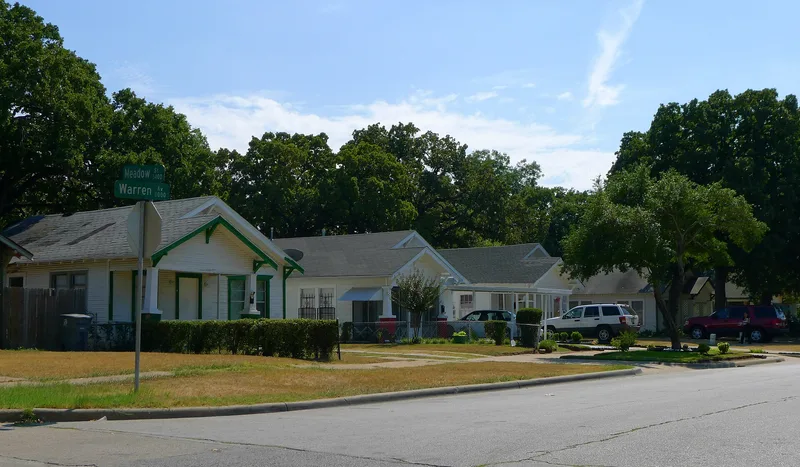
Wheatley Place is a residential neighborhood roughly two miles southeast of downtown Dallas, bounded by Warren, Atlanta, McDermott, Meadow, Oakland and Dathe streets. Of its 505 properties, over 500 are dwellings, with four institutional and eight commercial buildings, and 373 buildings were counted as contributing to its historic character. Most houses are wood-frame bungalows with Craftsman-inspired details such as tapered wooden porch columns, wood double-hung windows, and gable or hip roofs. Brick appears mainly in foundations, porch piers and chimneys. Many homes date from about 1925 to 1935, and some have later siding or porch changes. The district was recognized for its architecture, its role in community planning and development, and its importance to Black ethnic heritage, with a period of significance from 1916 to 1945. The 132 noncontributing buildings are mostly post-1945 construction or heavily altered older houses. The architect or builder is not identified. The area remains primarily single-family housing.
Significance in brief: The nomination cites the district under criteria A and C, with areas of significance in architecture, community planning and development, and Black ethnic heritage. Its period of significance begins in 1916 and runs to 1945. The housing is described as largely Craftsman-style bungalows that retain their historic character.
Machine-generated summary. This summary was generated by a language model from the official nomination document and has not been reviewed line by line by an editor. It may contain errors. Check the source document before relying on any detail. Source: nomination document (PDF) · National Archives catalog entry. NRHP reference 95000331, listed March 23, 1995. Summary generated October 2026 (model claude-sonnet-5-5, prompt v1.0-2026-10-29, confidence medium).
Key facts
| Address | Bounded by Warren, Atlanta, McDermott, Meadow, Oakland and Dathe, Dallas |
|---|---|
| County | Dallas County |
| Listed | March 23, 1995 |
| Reference number | 95000331 |
| Resource type | District |
| Period of significance | 1916-1945 |
| Architect / builder | Unknown |
| Architectural style | Late 19th and Early 20th Century American Movements: Bungalow/Craftsman |
| Criteria |
|
| Areas of significance | Architecture, Community Planning and Development, Black |
| Level of significance | Local |
| Status (as stated in the nomination) | Historic and current function is single-dwelling domestic use; the 1995 count lists 373 contributing and 132 noncontributing buildings. |
| Acreage | 98 |
| Coordinates | 32.76466, -96.76690 (NPS GIS) |
What listing means for this property
This is a historic district. Buildings within its boundary are either contributing (they add to the district's significance) or non-contributing. Owners of contributing income-producing buildings can claim the 20% federal rehabilitation tax credit; homeowners should look at state credits. National Register districts impose no design review by themselves; a local historic district ordinance, if one exists, does (the difference explained).
General information, not legal or tax advice. Rules change; confirm with your State Historic Preservation Office or a qualified adviser.
Sources and further reading
- National Park Service, National Register of Historic Places database (snapshot May 2026), reference 95000331.
- Nomination form (PDF, National Archives) — catalog entry
- Wikipedia article (used for cross-checking only; text not reproduced here)
- Wikidata Q7991936
- This listing as JSON
Last updated October 2026. Found an error? See the editorial policy for how to report it.