Gruene Historic District
Why it's listed
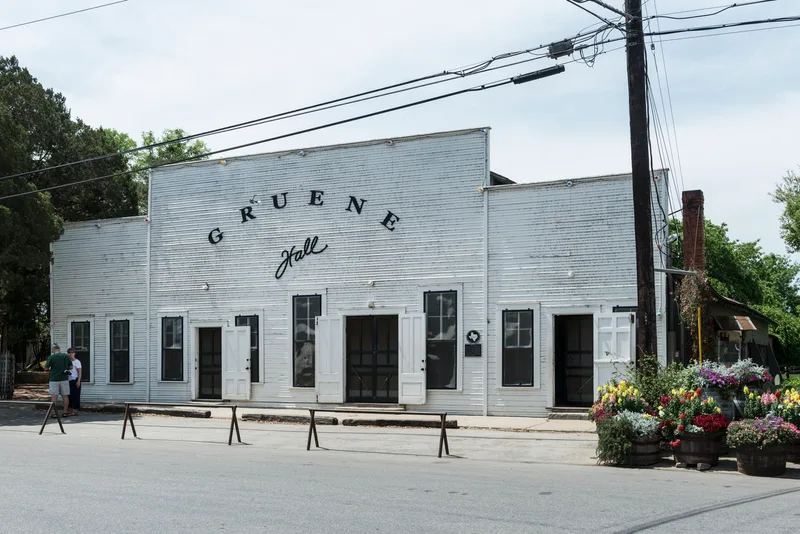
Gruene is a small Texas community on the east bluff above the Guadalupe River, about four miles northeast of New Braunfels. Henry D. Gruene built it up from the 1870s as a cotton town, drawing tenant farmers and providing a mercantile store, a water-powered cotton gin, a dance hall, a school site, a bank and a post office. The district includes his mansion, enlarged in 1886 by builder Christian Herry, modest employee and family cottages, a 1904 two-story brick store, Gruene Hall, a boiler house and a tall water tower. A few mid-nineteenth century German fachwerk houses carry later Victorian additions. The town sat on the road between San Antonio and Austin and gained two railroad depots. The boll weevil, the Depression and a rerouted highway ended its growth, and little was built after the 1920s. That lack of change preserved its late nineteenth century character, which led to the district's recognition.
Significance in brief: The district keeps the look of a late nineteenth century cotton community, with Victorian houses and a few mid-nineteenth century German colonial structures with Victorian additions. Little was built after the 1920s. It reflects the ambitions of founder Henry D. Gruene, whose store, gin, dance hall and tenant-farm system shaped the town, which also served as a stage stop and railroad station stop.
Machine-generated summary. This summary was generated by a language model from the official nomination document and has not been reviewed line by line by an editor. It may contain errors. Check the source document before relying on any detail. Source: nomination document (PDF) · National Archives catalog entry. NRHP reference 75001962, listed April 21, 1975. Summary generated October 2026 (model claude-sonnet-5-5, prompt v1.0-2026-10-29, confidence medium).
Key facts
| Address | Both sides of Sequin, New Braunfels, and Austin Sts., Gruene |
|---|---|
| County | Comal County |
| Listed | April 21, 1975 |
| Reference number | 75001962 |
| Resource type | District |
| Architect / builder | Christian Herry |
| Architectural style | German Colonial fachwerk and Victorian |
| Areas of significance | Transportation, Architecture |
| Level of significance | Local |
| Status (as stated in the nomination) | Condition listed as fair and altered. Buildings include a saddle tree factory in the 1904 mercantile store, a boiler house with deteriorated brick, and an electric cotton gin of which only the shell remains. Houses were being sold and restored at the time of nomination. |
| Acreage | 25 |
| Coordinates | 29.73906, -98.10357 (NPS GIS) |
What listing means for this property
This is a historic district. Buildings within its boundary are either contributing (they add to the district's significance) or non-contributing. Owners of contributing income-producing buildings can claim the 20% federal rehabilitation tax credit; homeowners should look at state credits. National Register districts impose no design review by themselves; a local historic district ordinance, if one exists, does (the difference explained).
General information, not legal or tax advice. Rules change; confirm with your State Historic Preservation Office or a qualified adviser.
Sources and further reading
- National Park Service, National Register of Historic Places database (snapshot May 2026), reference 75001962.
- Nomination form (PDF, National Archives) — catalog entry
- Wikidata Q75295306
- This listing as JSON
Last updated October 2026. Found an error? See the editorial policy for how to report it.