Stoner, Samuel, Homestead
Also known as: Indian Road Farm; Bechtel Farm; Wiest Dam

Why it's listed
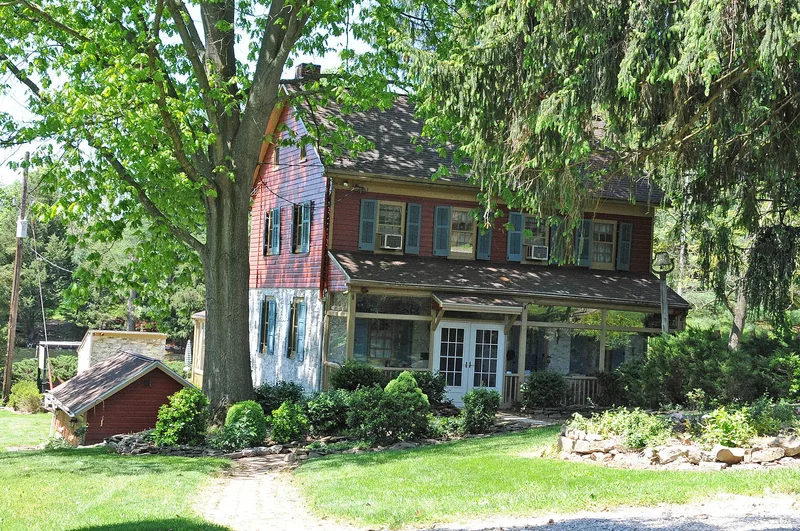
A stone farmhouse in West Manchester Township, York County, Pennsylvania, begun by Samuel Stoner between 1798 and 1801 in the German style as a one-and-a-half-story house. A full second story was added in the 1830s, and a two-story stone rear wing followed in the 1850s. The interior retains much of its original woodwork, including beaded moldings, pegged sunken panels in the living room, and a sponge-decorated ceiling. The basement kitchen has a large walk-in fireplace and an exposed spring that runs through a stone channel to an outside spring house. Three mid-nineteenth-century outbuildings survive. Dr. Charles Nes lived here in the 1860s and 1870s, when he developed Nes Silicon Steel, and General Michael Doudle, a militia leader and Pennsylvania state legislator, was also a resident. Of the original farm of more than 120 acres, only six remain, the rest being inundated by the Indian Rock Dam.
Significance in brief: The nomination describes the house as a good example of a late 18th-century rural Pennsylvania farmhouse, with largely original interior woodwork and a sponge-decorated living room ceiling. It also cites its association with Dr. Charles Nes, who developed Nes Silicon Steel while living there in the 1860s and 1870s, and with General Michael Doudle, a local militia and political leader.
Machine-generated summary. This summary was generated by a language model from the official nomination document and has not been reviewed line by line by an editor. It may contain errors. Check the source document before relying on any detail. Source: nomination document (PDF) · National Archives catalog entry. NRHP reference 76001684, listed January 30, 1976. Summary generated October 2026 (model claude-haiku-5-5, prompt v1.1-2026-10-29, confidence medium).
Key facts
| Address | S of York off PA 182, York |
|---|---|
| County | York County |
| Listed | January 30, 1976 |
| Reference number | 76001684 |
| Resource type | Building |
| Period of significance | c. 1800-1850 |
| Architect / builder | Samuel Stoner (original builder) |
| Architectural style | German style stone house; Vernacular |
| Areas of significance | Architecture, Invention |
| Level of significance | Local |
| Acreage | 6 |
| Coordinates | 39.92382, -76.76310 (NPS GIS) |
What listing means for this property
National Register listing is honorary for a privately owned home: it does not by itself restrict what an owner may do with their own money, and it does not require public access. Restrictions come from local landmark or historic-district ordinances, which are separate (how they differ).
Owner-occupied houses are not eligible for the 20% federal rehabilitation tax credit, which applies to income-producing buildings, but many states offer credits for homeowners. Listing also opens the door to preservation easements and to buying a plaque. Start with what listing means for homeowners, renovating a listed house and selling one.
General information, not legal or tax advice. Rules change; confirm with your State Historic Preservation Office or a qualified adviser.
Sources and further reading
- National Park Service, National Register of Historic Places database (snapshot May 2026), reference 76001684.
- Nomination form (PDF, National Archives) — catalog entry
- Wikipedia article (used for cross-checking only; text not reproduced here)
- Wikidata Q7412712
- This listing as JSON
Last updated October 2026. Found an error? See the editorial policy for how to report it.