Gates, Gen. Horatio, House, and Golden Plough Tavern

Why it's listed
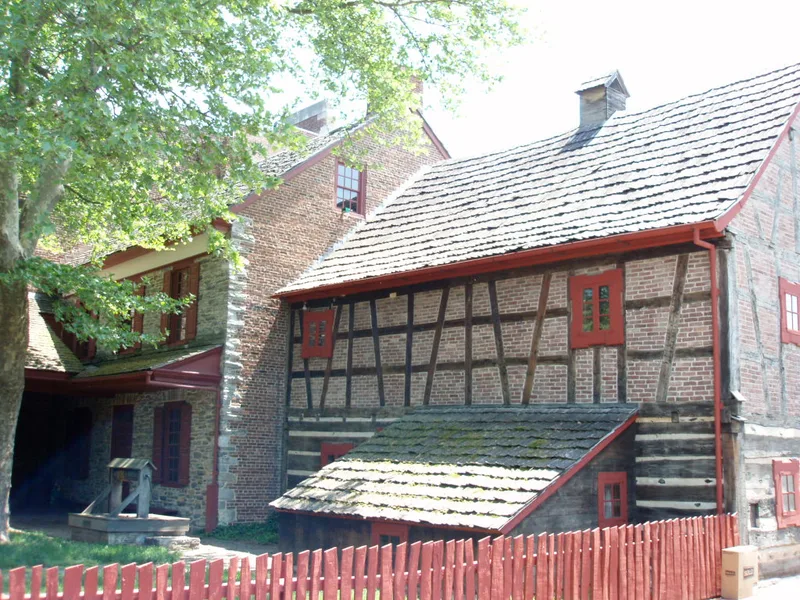
Two adjoining buildings on West Market Street in York illustrate the mid-eighteenth-century mix of German and English building traditions. The Golden Plough Tavern, built in 1741 by Michael Eichelberger on lot 120 of Thomas Cookson's plan of York, is a two-story structure with a central chimney, horizontal log walls on the first floor and half-timbered upper stories with brick nogging. Next door, the General Gates House, built in 1751 by Joseph Chambers, is a Georgian house of blue limestone with a symmetrical facade, two end chimneys and a center hall. General Horatio Gates rented the house in 1778 while Congress sat in York. A banquet held there is said to have ended the Conway Cabal after Lafayette proposed a toast to Washington. Both buildings were restored between 1961 and 1964, and their interiors hold furniture dating to before 1780 and 1760.
Significance in brief: The Gates House is significant for its Georgian architecture and for a banquet held there during the Continental Congress's stay in York, where Lafayette's toast to Washington is said to have ended the Conway Cabal. The Golden Plough Tavern is described as probably the most important surviving building of York's architectural history, the only remaining example in the town of a medieval half-timber type of construction used by early German settlers. Its combination of log and half-timber construction is noted as possibly unique in America.
Machine-generated summary. This summary was generated by a language model from the official nomination document and has not been reviewed line by line by an editor. It may contain errors. Check the source document before relying on any detail. Source: nomination document (PDF) · National Archives catalog entry. NRHP reference 71000737, listed December 6, 1971. Summary generated October 2026 (model claude-haiku-5-5, prompt v1.1-2026-10-29, confidence high).
Key facts
| Address | 157-159 W. Market St., York |
|---|---|
| County | York County |
| Listed | December 6, 1971 |
| Reference number | 71000737 |
| Resource type | Building |
| Period of significance | 1741-1780 |
| Architect / builder | Michael (or Martin) Eichelberger (builder, Golden Plough Tavern); Joseph Chambers (builder, General Gates House) |
| Architectural style | Georgian (General Gates House); medieval German half-timber (Golden Plough Tavern) |
| Areas of significance | Military, Architecture |
| Level of significance | National |
| Status (as stated in the nomination) | Restored between 1961 and 1964 under the supervision of G. Edwin Brumbaugh; both are in the Original Site position and in altered condition as marked on the form. |
| Acreage | 1 |
| Within district | York Historic District |
| Coordinates | 39.96208, -76.72943 (NPS GIS) |
What listing means for this property
For an income-producing building, listing (individually or as a contributing building in a district) is the gateway to the 20% federal rehabilitation tax credit on qualified rehabilitation costs, often stackable with state credits. Work claiming the credit must follow the Secretary of the Interior's Standards and be approved in advance.
Listing does not restrict a private owner acting without federal money or permits; where federal funding or licensing is involved, Section 106 review applies.
General information, not legal or tax advice. Rules change; confirm with your State Historic Preservation Office or a qualified adviser.
Sources and further reading
- National Park Service, National Register of Historic Places database (snapshot May 2026), reference 71000737.
- Nomination form (PDF, National Archives) — catalog entry
- Wikipedia article (used for cross-checking only; text not reproduced here)
- Wikidata Q15221813
- This listing as JSON
Last updated October 2026. Found an error? See the editorial policy for how to report it.