U.S. Naval Home
Also known as: Naval Asylum

Why it's listed
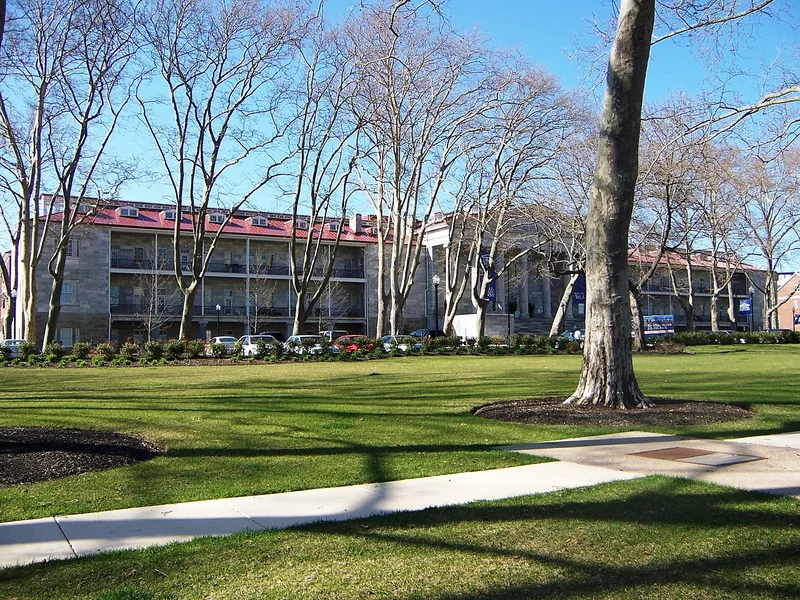
Built beginning in 1827 in Philadelphia as the Naval Asylum, this institutional building was designed by William Strickland as a home for disabled and aging Navy officers, seamen and marines. Its central portico has a Greek Revival design with an Ionic order, and the wings are fronted by open piazzas where convalescent residents could take in fresh air. The piazzas are supported by eighty-eight cast iron colonnettes, which the nomination describes as an early use of metal supports chosen for strength, economy and resistance to fire. The main block is built of Pennsylvania marble with granite basement walls and was fireproofed with vaulting throughout. Two flanking residences designed by Strickland in 1844 for the Governor and Chief Medical Officer carry naval ironwork of anchors, ropes and dolphins. The building also housed the United States Naval Academy from 1839 until 1845, when the Academy moved to Annapolis. It is regarded as one of Strickland's most important works.
Significance in brief: The nomination argues the building is one of William Strickland's finest works, combining a pure Greek Revival portico with a utilitarian institutional building. Its open piazzas with early cast iron colonnettes are described as among the earliest constructional uses of iron. It also served as the first home of the United States Naval Academy from 1839 until 1845.
Machine-generated summary. This summary was generated by a language model from the official nomination document and has not been reviewed line by line by an editor. It may contain errors. Check the source document before relying on any detail. Source: nomination document (PDF) · National Archives catalog entry. NRHP reference 72001173, listed August 21, 1972. Summary generated October 2026 (model claude-haiku-5-5, prompt v1.1-2026-10-29, confidence medium).
Key facts
| Address | Gray's Ferry Ave. at 24th St., Philadelphia |
|---|---|
| County | Philadelphia |
| Listed | August 21, 1972 |
| Reference number | 72001173 |
| Resource type | Building |
| Period of significance | 1827-1833, 1844 |
| Architect / builder | William Strickland (architect) |
| Architectural style | Greek Revival |
| Areas of significance | Military, Architecture, Social History |
| Level of significance | National |
| National Historic Landmark | Yes, designated January 7, 1976 |
| Status (as stated in the nomination) | The document states the Naval Home is still in use and presently occupied by about 200 residents. |
| Acreage | 20 |
| Coordinates | 39.94385, -75.18438 (NPS GIS) |
What listing means for this property
National Register listing is honorary for a privately owned home: it does not by itself restrict what an owner may do with their own money, and it does not require public access. Restrictions come from local landmark or historic-district ordinances, which are separate (how they differ).
Owner-occupied houses are not eligible for the 20% federal rehabilitation tax credit, which applies to income-producing buildings, but many states offer credits for homeowners. Listing also opens the door to preservation easements and to buying a plaque. Start with what listing means for homeowners, renovating a listed house and selling one.
General information, not legal or tax advice. Rules change; confirm with your State Historic Preservation Office or a qualified adviser.
Sources and further reading
- National Park Service, National Register of Historic Places database (snapshot May 2026), reference 72001173.
- Nomination form (PDF, National Archives) — catalog entry
- Wikipedia article (used for cross-checking only; text not reproduced here)
- Wikidata Q7182753
- This listing as JSON
Last updated October 2026. Found an error? See the editorial policy for how to report it.