Mother Bethel A.M.E. Church

Why it's listed
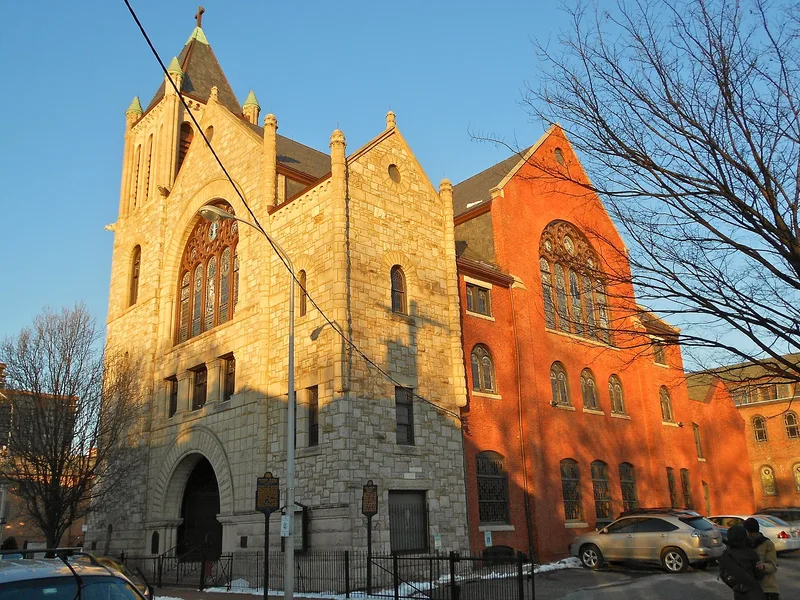
Mother Bethel A.M.E. Church stands at Sixth and Lombard Streets in Philadelphia, on a lot Richard Allen purchased in 1793 with the help of Dr. Benjamin Rush. Allen, a former slave and unordained itinerant preacher, had left St. George's Methodist Church in 1787 with about 42 followers in protest against its segregated worship. The congregation later became the mother church of the African Methodist Episcopal Church in America, which gives the building its name. The first church on the site was replaced in 1805 by a red brick structure, and in 1889 that was torn down for a larger building. The present church has a granite three-story front, a four-story tower, a large circular-headed doorway and stained glass windows made in Heidelberg, Germany. A tunnel linked it to the Friends Meeting House at Fourth and Arch, and it was used as part of the underground railway by escaping slaves. Richard Allen is buried in the basement. The lot is regarded as the oldest parcel of real estate continuously owned by Black people in the United States.
Significance in brief: The nomination argues the church is significant as the mother church of the African Methodist Episcopal Church in America, founded by Richard Allen in 1793. It also cites the building's Victorian Romanesque Revival design and its stained glass windows made in Heidelberg, Germany. The document further links the site to the underground railway, through a tunnel to the Friends Meeting House.
Machine-generated summary. This summary was generated by a language model from the official nomination document and has not been reviewed line by line by an editor. It may contain errors. Check the source document before relying on any detail. Source: nomination document (PDF) · National Archives catalog entry. NRHP reference 72001166, listed March 16, 1972. Summary generated October 2026 (model claude-haiku-5-5, prompt v1.1-2026-10-29, confidence medium).
Key facts
| Address | 419 6th St., Philadelphia |
|---|---|
| County | Philadelphia |
| Listed | March 16, 1972 |
| Reference number | 72001166 |
| Resource type | Building |
| Period of significance | 19th Century |
| Architectural style | Victorian Romanesque Revival |
| Areas of significance | Black, Architecture, Religion, Social History |
| Level of significance | National |
| National Historic Landmark | Yes, designated May 30, 1974 |
| Status (as stated in the nomination) | The building is in good condition and is used daily. |
| Acreage | 1 |
| Within district | Society Hill Historic District |
| Coordinates | 39.94324, -75.15186 (NPS GIS) |
What listing means for this property
Religious properties are listed for their architectural or historical significance, not their religious use. Listing is honorary and does not restrict the congregation's use of the building. The federal rehabilitation credit is generally unavailable unless part of the building is income-producing; some state programmes and preservation grants do cover religious buildings. Federal funding or permits trigger Section 106 review.
General information, not legal or tax advice. Rules change; confirm with your State Historic Preservation Office or a qualified adviser.
Sources and further reading
- National Park Service, National Register of Historic Places database (snapshot May 2026), reference 72001166.
- Nomination form (PDF, National Archives) — catalog entry
- Wikipedia article (used for cross-checking only; text not reproduced here)
- Wikidata Q6917303
- This listing as JSON
Last updated October 2026. Found an error? See the editorial policy for how to report it.