Metropolitan Opera House
Also known as: The Met; Philadelphia Evangelistic Center

Why it's listed
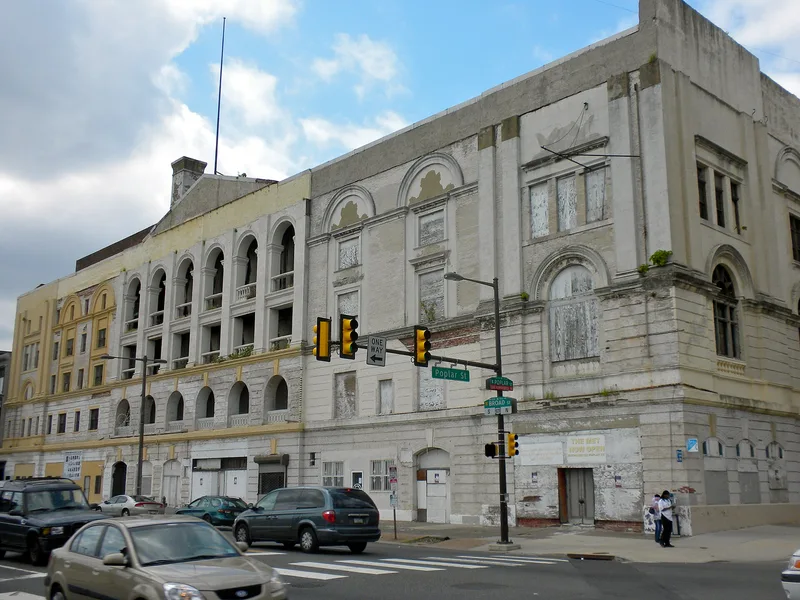
Built on the southwest corner of Broad and Poplar Streets, the Metropolitan Opera House was designed by William H. Elfatrick of Brooklyn, a specialist in theatrical structures. Its neo-classical design uses ivory white Philadelphia pressed brick, terra cotta and white marble, with rusticated brickwork on the first two stories and a pedimented center on both street fronts. The Broad Street facade is five bays wide and the Poplar Street facade three. The interior once seated more than 4,000 people and included 28 grand tier boxes and an orchestra pit for 120 musicians. Begun in April 1908, it opened in November that year with a performance of Carmen, and it was one of two opera houses in Philadelphia at a time when the city briefly shared that distinction with Paris and New York. Major singers of the era performed there, and several operas given in Philadelphia were first staged in the city here. Opera ran until 1920, after which the building hosted vaudeville, revivals, sports, dances and union meetings. A 1948 fire destroyed much of the interior, and later alterations followed.
Significance in brief: The building opened in 1908 as Oscar Hammerstein's opera house, a period when Philadelphia briefly had two opera houses. It hosted major operatic stars and Philadelphia premieres, and its exterior and history reflect the opulence of turn-of-the-century Philadelphia society and changing uses along North Broad Street.
Machine-generated summary. This summary was generated by a language model from the official nomination document and has not been reviewed line by line by an editor. It may contain errors. Check the source document before relying on any detail. Source: nomination document (PDF) · National Archives catalog entry. NRHP reference 72001163, listed February 1, 1972. Summary generated October 2026 (model claude-haiku-5-5, prompt v1.1-2026-10-29, confidence medium).
Key facts
| Address | 858 N. Broad St., Philadelphia |
|---|---|
| County | Philadelphia |
| Listed | February 1, 1972 |
| Reference number | 72001163 |
| Resource type | Building |
| Period of significance | 1908 |
| Architect / builder | William H. Elfatrick (architect) |
| Architectural style | Neo-classical |
| Areas of significance | Performing Arts |
| Level of significance | National |
| Status (as stated in the nomination) | Now the Philadelphia Evangelistic Center; altered after a 1948 fire and later uses. |
| Acreage | 0.9 |
| Coordinates | 39.97038, -75.16005 (NPS GIS) |
What listing means for this property
National Register listing is honorary for a privately owned home: it does not by itself restrict what an owner may do with their own money, and it does not require public access. Restrictions come from local landmark or historic-district ordinances, which are separate (how they differ).
Owner-occupied houses are not eligible for the 20% federal rehabilitation tax credit, which applies to income-producing buildings, but many states offer credits for homeowners. Listing also opens the door to preservation easements and to buying a plaque. Start with what listing means for homeowners, renovating a listed house and selling one.
General information, not legal or tax advice. Rules change; confirm with your State Historic Preservation Office or a qualified adviser.
Sources and further reading
- National Park Service, National Register of Historic Places database (snapshot May 2026), reference 72001163.
- Nomination form (PDF, National Archives) — catalog entry
- Wikipedia article (used for cross-checking only; text not reproduced here)
- Wikidata Q6825168
- This listing as JSON
Last updated October 2026. Found an error? See the editorial policy for how to report it.