Eakins, Thomas, House

Why it's listed
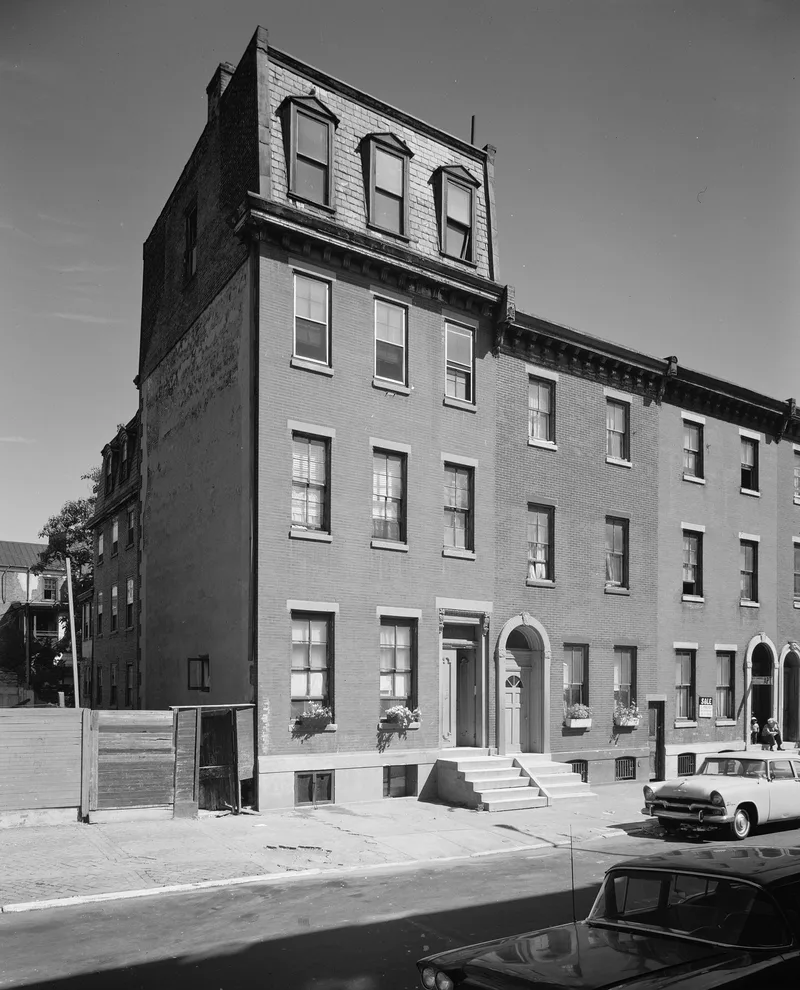
A four-story townhouse at 1729 Mount Vernon Place in Philadelphia, built about 1854, with three brick stories and a wood fourth story, white marble steps, and marble sills and lintels on the front door and first three floors. Thomas Eakins' father bought the house in 1857 when the painter was two years old, and Eakins lived there until his death in 1916, inheriting it in 1899. Eakins was born in Philadelphia in 1844, studied at the Pennsylvania Academy of the Fine Arts, and spent three years in Paris before returning to the city in 1870. He taught at the Academy from 1873 until his forced retirement in February 1886, after a dispute over his use of nude models and his insistence on dissection and anatomy study. The house is regarded as the setting of a painter known for realistic portraits, including his 1887 portrait of Walt Whitman, and for works such as The Gross Clinic and The Agnew Clinic. The building is associated with his working life in the city.
Significance in brief: The nomination argues that Eakins was a painter of exceptional dedication whose realism and portraiture reflected his independent vision despite criticism from Philadelphia society. It also points to his influential teaching at the Pennsylvania Academy of the Fine Arts and to the house as the place where he lived and worked for decades.
Machine-generated summary. This summary was generated by a language model from the official nomination document and has not been reviewed line by line by an editor. It may contain errors. Check the source document before relying on any detail. Source: nomination document (PDF) · National Archives catalog entry. NRHP reference 66000679, listed October 15, 1966. Summary generated October 2026 (model claude-haiku-5-5, prompt v1.1-2026-10-29, confidence medium).
Key facts
| Address | 1729 Mount Vernon Pl., Philadelphia |
|---|---|
| County | Philadelphia |
| Listed | October 15, 1966 |
| Reference number | 66000679 |
| Resource type | Building |
| Period of significance | 1857-1916 |
| Areas of significance | Art |
| Level of significance | National |
| National Historic Landmark | Yes, designated December 21, 1965 |
| Status (as stated in the nomination) | Undergoing renovation by the City of Philadelphia for future use as a museum; the Present Condition section also describes it as in poor condition and converted to an apartment building. |
| Acreage | 0.1 |
| Within district | Spring Garden District |
| Coordinates | 39.96546, -75.16695 (NPS GIS) |
What listing means for this property
National Register listing is honorary for a privately owned home: it does not by itself restrict what an owner may do with their own money, and it does not require public access. Restrictions come from local landmark or historic-district ordinances, which are separate (how they differ).
Owner-occupied houses are not eligible for the 20% federal rehabilitation tax credit, which applies to income-producing buildings, but many states offer credits for homeowners. Listing also opens the door to preservation easements and to buying a plaque. Start with what listing means for homeowners, renovating a listed house and selling one.
General information, not legal or tax advice. Rules change; confirm with your State Historic Preservation Office or a qualified adviser.
Sources and further reading
- National Park Service, National Register of Historic Places database (snapshot May 2026), reference 66000679.
- Nomination form (PDF, National Archives) — catalog entry
- Wikipedia article (used for cross-checking only; text not reproduced here)
- Wikidata Q7789216
- This listing as JSON
Last updated October 2026. Found an error? See the editorial policy for how to report it.