Budd, Edward G., Manufacturing Company
Also known as: The Budd Company

Why it's listed
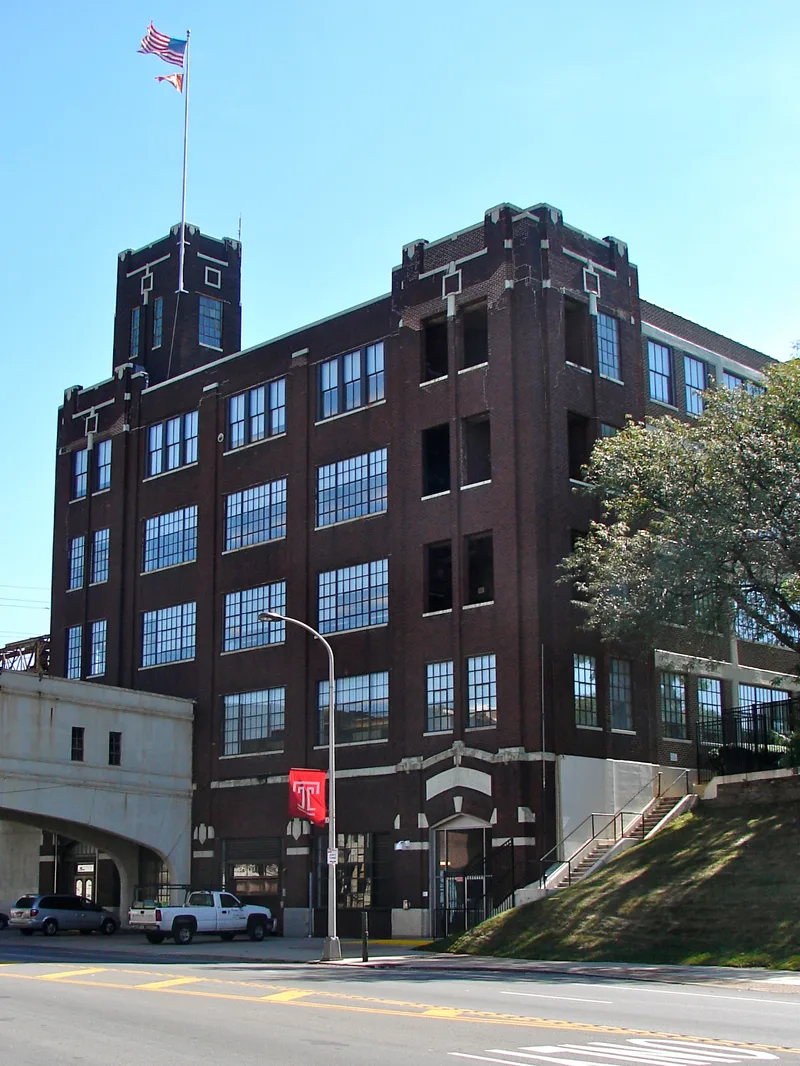
Built around the crossing of two railroad lines in northwest Philadelphia, this complex of brick and reinforced concrete industrial buildings grew from the first Budd structures erected in 1917. Its low and multi-story buildings, some up to six stories, were linked by enclosed conveyor bridges so that raw materials and finished products could move between units. The Edward G. Budd Manufacturing Company used the site to press and stamp sheet steel into automobile bodies, a method that replaced wooden bodies across much of the industry in the 1920s. The company later produced parts for the streamliner trains of the 1930s and the Conestoga military aircraft of World War II. Most of the buildings date from 1917 to 1945 and still appear largely as they did in that period, making the plant a clear record of early mass production in Philadelphia. The site was occupied by the company until its Philadelphia operations closed in 2003.
Significance in brief: The nomination argues the company developed the use of pressed sheet steel for automobile bodies, a lighter, stronger and cheaper alternative to wooden bodies, and later applied the technology to streamliner trains and Conestoga military planes. The site is significant under Criterion A for its contribution to the transportation industry, with a period of significance of 1917 to 1945 covering the earliest Budd buildings through World War II.
Machine-generated summary. This summary was generated by a language model from the official nomination document and has not been reviewed line by line by an editor. It may contain errors. Check the source document before relying on any detail. Source: nomination document (PDF) · National Archives catalog entry. NRHP reference 07001328, listed December 27, 2007. Summary generated October 2026 (model claude-haiku-5-5, prompt v1.1-2026-10-29, confidence high).
Key facts
| Address | 2450 W Hunting Park Rd., Philadelphia |
|---|---|
| County | Philadelphia |
| Listed | December 27, 2007 |
| Reference number | 07001328 |
| Resource type | District |
| Period of significance | 1917-1945 |
| Architect / builder | Giffels & Vallet, Inc., Engineers and Architects; Albert Kahn & Associates, Architects and Engineers |
| Architectural style | 20th Century Industrial |
| Criteria |
|
| Areas of significance | Industry |
| Level of significance | Local |
| Status (as stated in the nomination) | The Budd company vacated the site in 2003; all machinery and furnishings were removed at that time, and the buildings retain a high level of integrity. |
| Acreage | 70 |
| Coordinates | 40.00938, -75.17169 (NPS GIS) |
What listing means for this property
This is a historic district. Buildings within its boundary are either contributing (they add to the district's significance) or non-contributing. Owners of contributing income-producing buildings can claim the 20% federal rehabilitation tax credit; homeowners should look at state credits. National Register districts impose no design review by themselves; a local historic district ordinance, if one exists, does (the difference explained).
Noted as vacant in the nomination. Nomination documents can be decades old; current status may differ. If you are considering buying an empty listed property, read the due-diligence checklist.
General information, not legal or tax advice. Rules change; confirm with your State Historic Preservation Office or a qualified adviser.
Sources and further reading
- National Park Service, National Register of Historic Places database (snapshot May 2026), reference 07001328.
- Nomination form (PDF, National Archives) — catalog entry
- Wikidata Q24256347
- This listing as JSON
Last updated October 2026. Found an error? See the editorial policy for how to report it.