Arch Street Presbyterian Church

Why it's listed
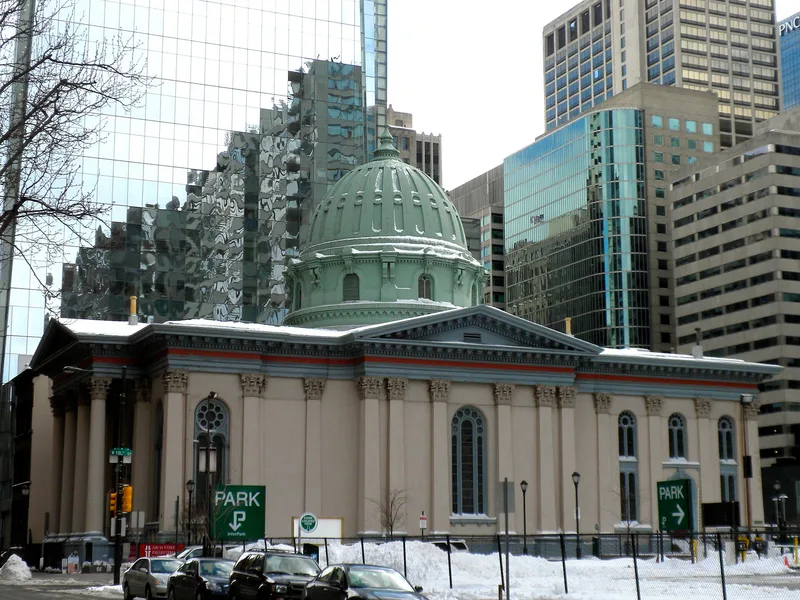
Built in Philadelphia as a one-story Classical Revival church, Arch Street Presbyterian Church was dedicated in 1855. Its architect was Joseph C. Hoxie, who worked on the construction with his brother-in-law, Stephen Decatur Button. The exterior has a portico supported on four giant Corinthian columns, with Corinthian pilasters along the walls and a coffered dome. The sanctuary holds 16 Corinthian columns, 22 antae, the dome and a pulpit platform. The central pulpit is made of marble and modeled on a Greek votive altar. The interior mixes Greek and Roman elements and is suggestive in some ways of the Parthenon. Architectural historians have regarded the interior as a masterpiece of the classical revival, and the nomination records that its interiors remain in excellent condition. The church is also associated with visits by Emily Dickinson and the future King Edward VII, and with the Sunday School service of former Pennsylvania governor James Pollock, later director of the Mint.
Significance in brief: The nomination argues the sanctuary is one of the most notable examples of Greek-inspired architecture in the city, with a monumental interior regarded by some architects as a masterpiece of the classical revival. It also cites the church's historic associations with several well-known visitors and members.
Machine-generated summary. This summary was generated by a language model from the official nomination document and has not been reviewed line by line by an editor. It may contain errors. Check the source document before relying on any detail. Source: nomination document (PDF) · National Archives catalog entry. NRHP reference 71000717, listed May 27, 1971. Summary generated October 2026 (model claude-haiku-5-5, prompt v1.1-2026-10-29, confidence medium).
Key facts
| Address | 1726-1732 Arch St., Philadelphia |
|---|---|
| County | Philadelphia |
| Listed | May 27, 1971 |
| Reference number | 71000717 |
| Resource type | Building |
| Period of significance | 1855 |
| Architect / builder | Joseph C. Hoxie (architect); Stephen Decatur Button, brother-in-law of Hoxie, associated in the construction |
| Architectural style | Classical Revival |
| Criteria |
|
| Areas of significance | Architecture |
| Level of significance | National |
| Status (as stated in the nomination) | Condition marked good to excellent; the magnificent interiors are stated to remain in excellent condition, with no major exterior alterations; original site. |
| Acreage | 0.9 |
| Coordinates | 39.95455, -75.16935 (NPS GIS) |
What listing means for this property
Religious properties are listed for their architectural or historical significance, not their religious use. Listing is honorary and does not restrict the congregation's use of the building. The federal rehabilitation credit is generally unavailable unless part of the building is income-producing; some state programmes and preservation grants do cover religious buildings. Federal funding or permits trigger Section 106 review.
General information, not legal or tax advice. Rules change; confirm with your State Historic Preservation Office or a qualified adviser.
Sources and further reading
- National Park Service, National Register of Historic Places database (snapshot May 2026), reference 71000717.
- Nomination form (PDF, National Archives) — catalog entry
- Wikipedia article (used for cross-checking only; text not reproduced here)
- Wikidata Q4785328
- This listing as JSON
Last updated October 2026. Found an error? See the editorial policy for how to report it.