Quaker Manor House

Why it's listed
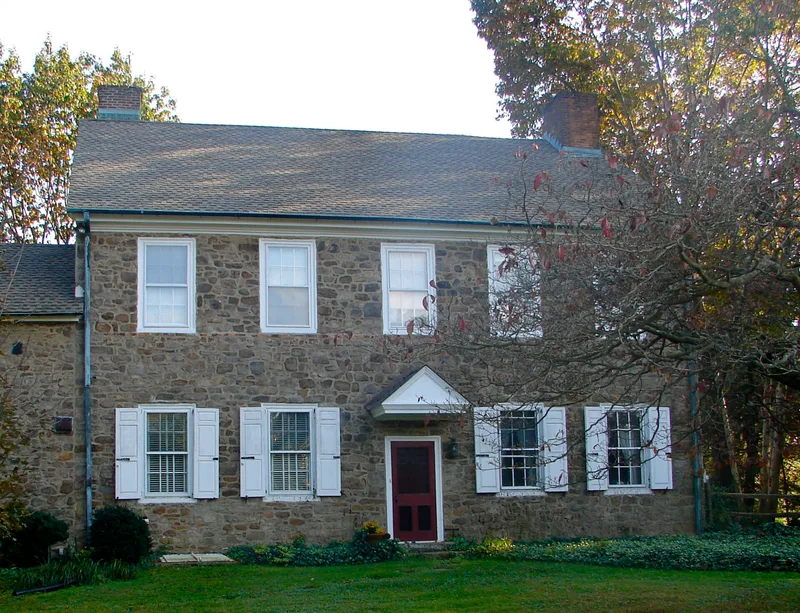
Stone house in Fort Washington, Montgomery County, Pennsylvania, believed built about 1730 and described as an example of a colonial Quaker farmhouse. Its main block is five bays wide and two bays deep, with a smaller kitchen wing added around 1760. The main block had its interiors remodeled in the early Federal period, while exterior cornice details and some original trim remain. John Petty, an English-born fur trader and friend of James Logan, owned the property first and acted as an agent between the provincial government and the Indians. Jeremiah Warder, a Philadelphia merchant, owned it from 1774 until his death in 1783, and he was one of the Quakers arrested during the Revolution and sent to Virginia. During the Whitemarsh Encampment of late 1777, Continental troops under General Washington used the house as a camp hospital. The house is significant for these associations with early settlers and for its Revolutionary-era history.
Significance in brief: The nomination argues the house is significant for its association with John Petty, an early settler and agent dealing with Native Americans, and with Jeremiah Warder, a prominent Philadelphia merchant who owned it from 1774 to 1783. It also notes the house served as a camp hospital during the Whitemarsh Encampment of 1777.
Machine-generated summary. This summary was generated by a language model from the official nomination document and has not been reviewed line by line by an editor. It may contain errors. Check the source document before relying on any detail. Source: nomination document (PDF) · National Archives catalog entry. NRHP reference 76001654, listed November 21, 1976. Summary generated October 2026 (model claude-haiku-5-5, prompt v1.1-2026-10-29, confidence medium).
Key facts
| Address | 1165 Pinetown Rd., Fort Washington |
|---|---|
| County | Montgomery County |
| Listed | November 21, 1976 |
| Reference number | 76001654 |
| Resource type | Building |
| Period of significance | 1730-Present |
| Architectural style | Georgian |
| Areas of significance | Architecture |
| Level of significance | Local |
| Acreage | 2 |
| Coordinates | 40.14531, -75.18863 (NPS GIS) |
What listing means for this property
National Register listing is honorary for a privately owned home: it does not by itself restrict what an owner may do with their own money, and it does not require public access. Restrictions come from local landmark or historic-district ordinances, which are separate (how they differ).
Owner-occupied houses are not eligible for the 20% federal rehabilitation tax credit, which applies to income-producing buildings, but many states offer credits for homeowners. Listing also opens the door to preservation easements and to buying a plaque. Start with what listing means for homeowners, renovating a listed house and selling one.
General information, not legal or tax advice. Rules change; confirm with your State Historic Preservation Office or a qualified adviser.
Sources and further reading
- National Park Service, National Register of Historic Places database (snapshot May 2026), reference 76001654.
- Nomination form (PDF, National Archives) — catalog entry
- Wikipedia article (used for cross-checking only; text not reproduced here)
- Wikidata Q7268555
- This listing as JSON
Last updated October 2026. Found an error? See the editorial policy for how to report it.