Barrett, Rufus, Stone House
Also known as: Flatiron Building

Why it's listed
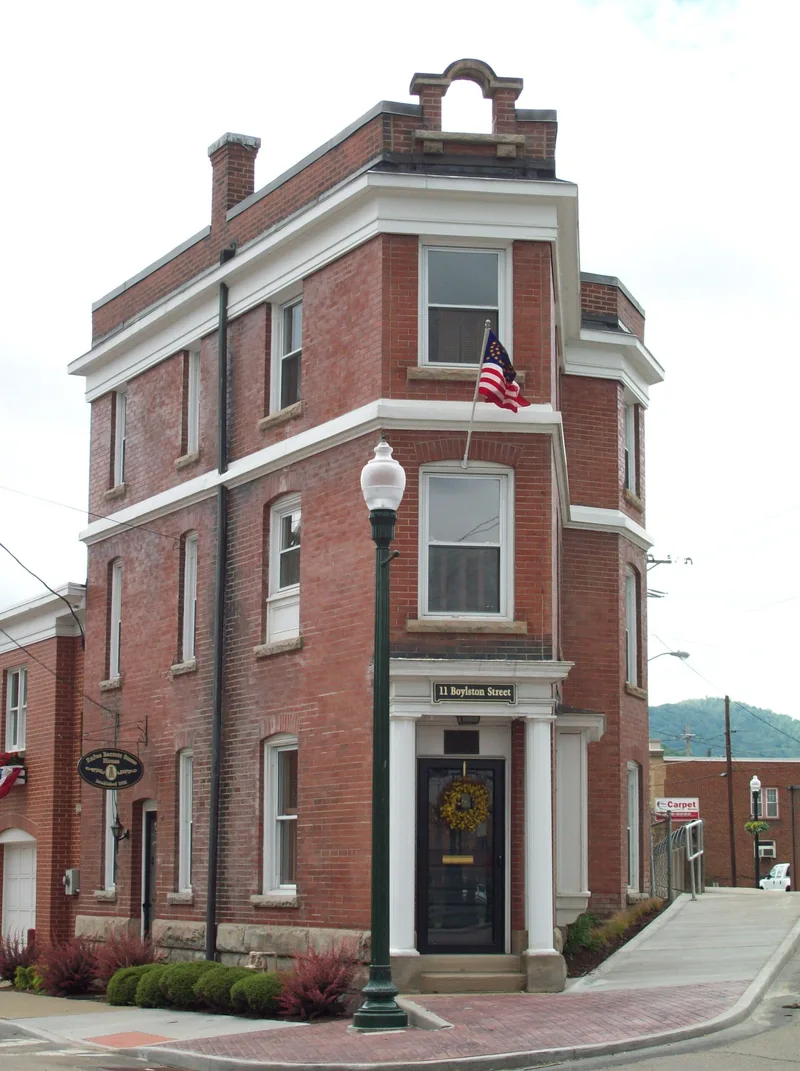
Built in 1903 as a combined law office and residence, this three-story, flat-roofed brick building occupies a triangular lot in Bradford where Tununguant Creek, East Washington Street and Boylston Street meet. Its walls are dry-pressed brick laid with raked joints, with foundations and decorative elements of native limestone and Genesee Valley bluestone, and brick and stone arched heads appear in the parapets. The front entrance sits at the sharp apex of the triangle beneath a one-story portico supported by Doric columns. Rufus Barrett Stone, a lawyer, built the structure and lived and worked there until his death in 1929. He was a leader in the early oil and industrial development of McKean County, serving as president of several companies, helping organize Bradford Hospital and the Carnegie Public Library, and founding the Bradford Evening Star. He was also active in Republican politics and served as U.S. Marshal in Mississippi during Reconstruction. The building is valued for its skilled masonry and its largely unaltered interior and exterior.
Significance in brief: The nomination argues the building is an imaginative flatiron design and an example of turn-of-the-century brickmasonry skill, and that it survives in almost its original state. It also ties the building to Stone, a leading figure in the commercial, oil and industrial development of McKean County and in local politics and philanthropy.
Machine-generated summary. This summary was generated by a language model from the official nomination document and has not been reviewed line by line by an editor. It may contain errors. Check the source document before relying on any detail. Source: nomination document (PDF) · National Archives catalog entry. NRHP reference 82001540, listed November 14, 1982. Summary generated October 2026 (model claude-haiku-5-5, prompt v1.1-2026-10-29, confidence medium).
Key facts
| Address | 11 Boylston St., Bradford |
|---|---|
| County | McKean County |
| Listed | November 14, 1982 |
| Reference number | 82001540 |
| Resource type | Building |
| Period of significance | 1903-1929 |
| Architect / builder | Rufus Barrett Stone (builder) |
| Criteria |
|
| Areas of significance | Architecture, Communications |
| Level of significance | Local |
| Status (as stated in the nomination) | Original purpose continues, and the building remains a prominent local landmark; the exterior and interior are said to be almost unchanged, with only the metal cornice noted as an exception. |
| Acreage | 0.1 |
| Within district | Bradford Downtown Historic District |
| Coordinates | 41.95671, -78.65005 (NPS GIS) |
What listing means for this property
National Register listing is honorary for a privately owned home: it does not by itself restrict what an owner may do with their own money, and it does not require public access. Restrictions come from local landmark or historic-district ordinances, which are separate (how they differ).
Owner-occupied houses are not eligible for the 20% federal rehabilitation tax credit, which applies to income-producing buildings, but many states offer credits for homeowners. Listing also opens the door to preservation easements and to buying a plaque. Start with what listing means for homeowners, renovating a listed house and selling one.
General information, not legal or tax advice. Rules change; confirm with your State Historic Preservation Office or a qualified adviser.
Sources and further reading
- National Park Service, National Register of Historic Places database (snapshot May 2026), reference 82001540.
- Nomination form (PDF, National Archives) — catalog entry
- Wikipedia article (used for cross-checking only; text not reproduced here)
- Wikidata Q7378002
- This listing as JSON
Last updated October 2026. Found an error? See the editorial policy for how to report it.