Massey, Thomas, House

Why it's listed
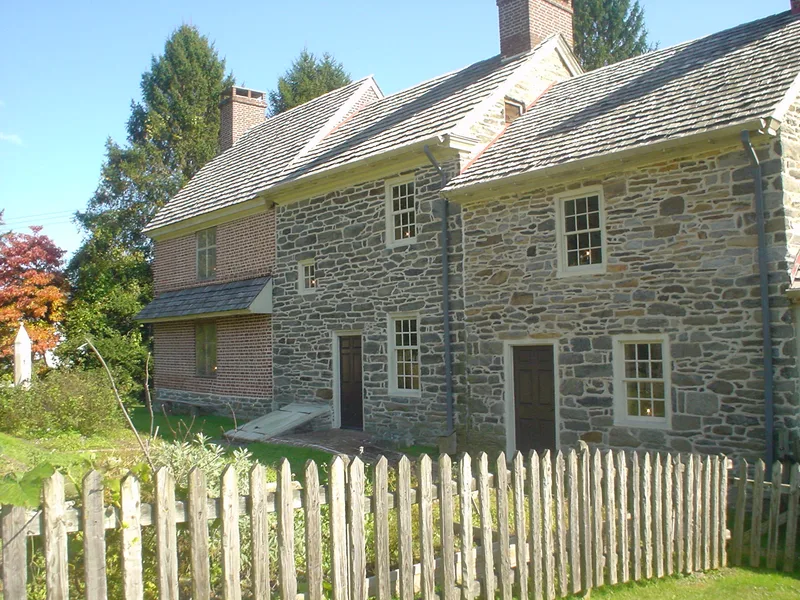
Built in stages beginning in 1696, this stone and brick farmhouse on Lawrence Road in Broomall, Marple Township, is a rare surviving example of Pennsylvania building across three centuries. Thomas Massey, a young indentured servant who arrived in 1683 and later became a township constable and official of the Friends Meeting, built the brick section as an addition to an earlier log house. His son Mordecai added a stone section about 1730 on the site of the log house, and further stone additions followed around 1840 and 1860. Restoration work, begun in 1964, uncovered original black walnut window frames, a pegged floor, a restored roof pitch using reused 1696 rafters, and poplar paneling never painted. The Massey family owned the house until 1925. The house is valued for its material evidence of early colonial farm life and for the record of its owners across generations.
Significance in brief: The nomination argues the house documents three centuries of Pennsylvania building, from the 17th-century log house through 18th- and 19th-century additions. Its 1696 brick section, original fabric revealed during restoration, and the history of Thomas Massey, an early Friends settler, are presented as representative of plain Pennsylvania farm life.
Machine-generated summary. This summary was generated by a language model from the official nomination document and has not been reviewed line by line by an editor. It may contain errors. Check the source document before relying on any detail. Source: nomination document (PDF) · National Archives catalog entry. NRHP reference 70000904, listed November 16, 1970. Summary generated October 2026 (model claude-haiku-5-5, prompt v1.1-2026-10-29, confidence medium).
Key facts
| Address | Lawrence and Springhouse Rds., Broomall |
|---|---|
| County | Delaware County |
| Listed | November 16, 1970 |
| Reference number | 70000904 |
| Resource type | Building |
| Period of significance | 17th Century-19th Century |
| Criteria |
|
| Areas of significance | Science, Architecture, Social History |
| Level of significance | National |
| Status (as stated in the nomination) | Restored; the 1930s modernization was reversed during restoration beginning in 1964 |
| Acreage | 1 |
| Coordinates | 39.96594, -75.35191 (NPS GIS) |
What listing means for this property
National Register listing is honorary for a privately owned home: it does not by itself restrict what an owner may do with their own money, and it does not require public access. Restrictions come from local landmark or historic-district ordinances, which are separate (how they differ).
Owner-occupied houses are not eligible for the 20% federal rehabilitation tax credit, which applies to income-producing buildings, but many states offer credits for homeowners. Listing also opens the door to preservation easements and to buying a plaque. Start with what listing means for homeowners, renovating a listed house and selling one.
General information, not legal or tax advice. Rules change; confirm with your State Historic Preservation Office or a qualified adviser.
Sources and further reading
- National Park Service, National Register of Historic Places database (snapshot May 2026), reference 70000904.
- Nomination form (PDF, National Archives) — catalog entry
- Wikipedia article (used for cross-checking only; text not reproduced here)
- Wikidata Q7792217
- This listing as JSON
Last updated October 2026. Found an error? See the editorial policy for how to report it.