Leiper, Thomas, Estate
Also known as: Avondale

Why it's listed
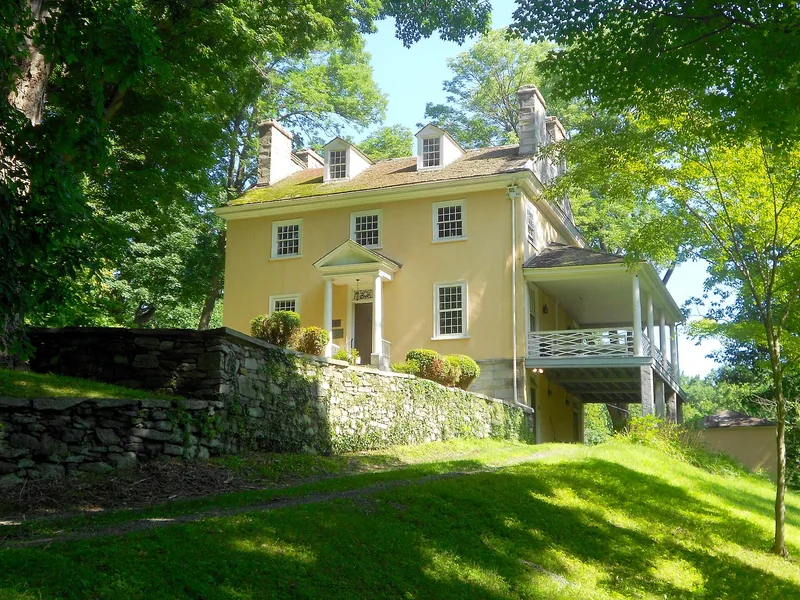
Built in 1785 on a hill above Crum Creek Valley in Wallingford, the three-storey yellow stuccoed mansion stands with a range of stone outbuildings, including barns, a springhouse, two snuff mills, a drying house, a log house and a smith shop. It was the home of Thomas Leiper, born in Scotland in 1745, who arrived in America in 1764 and built a fortune in the tobacco and snuff trade. In 1776 he bought land in Nether Providence Township and set up two snuff mills, and in 1809 he built a railroad to carry stone from his quarries to Ridley Creek, which the document describes as the first permanent railroad in the United States. The house is distinguished by its planning: a granite-railed drive leads to a pedimented entrance, a basement door connects the office to a vault in a fireproof outbuilding, and first-floor windows open into doors. The estate is valued for its largely unchanged industrial and architectural setting.
Significance in brief: The nomination argues the estate is a rare and nearly intact small eighteenth-century community built around the industrial and manufacturing activities of Thomas Leiper, a patriot, inventor and merchant. It cites the relatively unchanged Crum Creek site with its workmen's cottages, dam, mill, quarry and outbuildings, and the deliberate architectural design of the house and grounds in relation to its surroundings.
Machine-generated summary. This summary was generated by a language model from the official nomination document and has not been reviewed line by line by an editor. It may contain errors. Check the source document before relying on any detail. Source: nomination document (PDF) · National Archives catalog entry. NRHP reference 70000547, listed December 29, 1970. Summary generated October 2026 (model claude-haiku-5-5, prompt v1.1-2026-10-29, confidence medium).
Key facts
| Address | Avondale Rd., Wallingford |
|---|---|
| County | Delaware County |
| Listed | December 29, 1970 |
| Reference number | 70000547 |
| Resource type | Building |
| Period of significance | 1785 |
| Areas of significance | Architecture |
| Level of significance | National |
| Status (as stated in the nomination) | Condition is marked good and unaltered at original site; the document notes the estate was endangered by plans for the Midcounty Expressway. |
| Acreage | 6 |
| Coordinates | 39.88669, -75.35798 (NPS GIS) |
What listing means for this property
National Register listing is honorary for a privately owned home: it does not by itself restrict what an owner may do with their own money, and it does not require public access. Restrictions come from local landmark or historic-district ordinances, which are separate (how they differ).
Owner-occupied houses are not eligible for the 20% federal rehabilitation tax credit, which applies to income-producing buildings, but many states offer credits for homeowners. Listing also opens the door to preservation easements and to buying a plaque. Start with what listing means for homeowners, renovating a listed house and selling one.
General information, not legal or tax advice. Rules change; confirm with your State Historic Preservation Office or a qualified adviser.
Sources and further reading
- National Park Service, National Register of Historic Places database (snapshot May 2026), reference 70000547.
- Nomination form (PDF, National Archives) — catalog entry
- Wikipedia article (used for cross-checking only; text not reproduced here)
- Wikidata Q7791803
- This listing as JSON
Last updated October 2026. Found an error? See the editorial policy for how to report it.