Midtown Harrisburg Historic District

Why it's listed
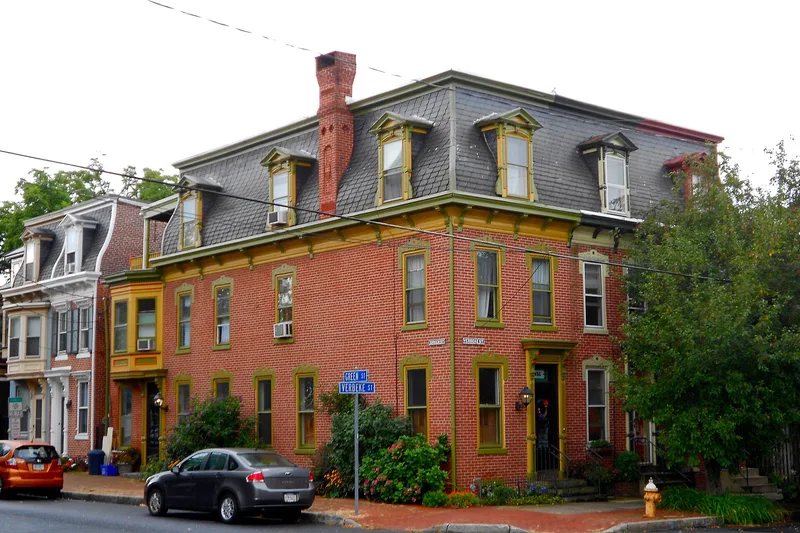
Midtown is a residential district of two and a half and three story brick and frame rows on the east bank side of downtown Harrisburg, built mostly between 1860 and 1910, with most dating from about 1875. Its rows were laid out in six subdivisions between 1857 and 1879, beginning with the William Verbeke tract of 1857. Second Street was the most prestigious address, lined with townhouses for professional and merchant families. The buildings show Italianate, Second Empire and Queen Anne detailing, including decorative wood brackets, corbelled brick cornices and mansard roofs, and the district is regarded as one of the most intact areas in the city. Its significance rests on the cohesion of its block fronts and its connection to River Front Park, developed in the early twentieth century under the City Beautiful movement, and to the Broad Street Market. Forster Street's widening in 1950 separated it from the neighborhood to the south.
Significance in brief: The district is described as one of the most architecturally intact areas in Harrisburg, with a continuous streetscape of rows and few alterations. It is regarded as one of the city's oldest principally residential districts and as representative of late nineteenth century urban America. Its significance is tied to its cohesive block fronts, architectural integrity, period of construction, and its relationship to the river, River Front Park and the Broad Street Market.
Machine-generated summary. This summary was generated by a language model from the official nomination document and has not been reviewed line by line by an editor. It may contain errors. Check the source document before relying on any detail. Source: nomination document (PDF) · National Archives catalog entry. NRHP reference 83002237, listed April 21, 1983. Summary generated October 2026 (model claude-haiku-5-5, prompt v1.1-2026-10-29, confidence medium).
Key facts
| Address | Roughly bounded by Susquehanna River, Forster, Verbeke, and 3rd Sts., Harrisburg |
|---|---|
| County | Dauphin County |
| Listed | April 21, 1983 |
| Reference number | 83002237 |
| Resource type | District |
| Period of significance | 1860-1910 |
| Architectural style | Italianate, Federal, Second Empire, Romanesque Revival, Queen Anne and Eastlake; Italianate, Second Empire and Queen Anne most common |
| Areas of significance | Community Planning and Development, Landscape Architecture, Exploration/Settlement, Architecture |
| Level of significance | Local |
| Status (as stated in the nomination) | Buildings are well maintained and generally well renovated or restored, with some sandblasting and aluminum siding intrusions; surface parking is an intrusion. |
| Acreage | 43 |
| Coordinates | 40.26713, -76.88931 (NPS GIS) |
What listing means for this property
This is a historic district. Buildings within its boundary are either contributing (they add to the district's significance) or non-contributing. Owners of contributing income-producing buildings can claim the 20% federal rehabilitation tax credit; homeowners should look at state credits. National Register districts impose no design review by themselves; a local historic district ordinance, if one exists, does (the difference explained).
General information, not legal or tax advice. Rules change; confirm with your State Historic Preservation Office or a qualified adviser.
Sources and further reading
- National Park Service, National Register of Historic Places database (snapshot May 2026), reference 83002237.
- Nomination form (PDF, National Archives) — catalog entry
- Wikipedia article (used for cross-checking only; text not reproduced here)
- Wikidata Q7084514
- This listing as JSON
Last updated October 2026. Found an error? See the editorial policy for how to report it.