Cameron, Simon, House and Bank

Why it's listed
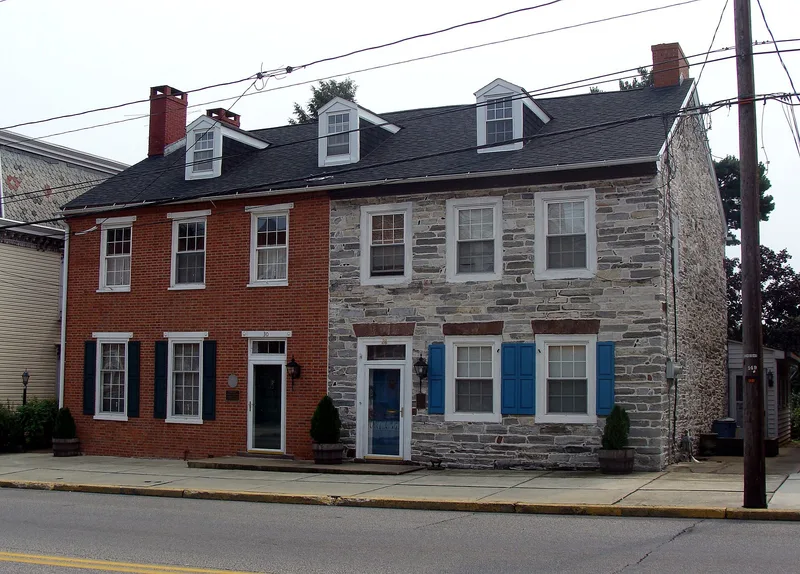
Two adjoining brick and stone buildings on East Main Street in Middletown, Pennsylvania, form a pair dating from the early nineteenth century. The stone building at number 28 was built as a residence around 1800 to 1810 and later housed the Bank of Middletown, organized in 1832. In 1833 Simon Cameron built the brick house at number 30 beside it, and the two share a common wall with doorways once linking them at each story. The house has high ceilings, large rooms, a grand hall stair and original woodwork. Cameron, who served as the bank's cashier from 1832 to 1850, later became Secretary of War under Abraham Lincoln and a United States senator. His son J. Donald Cameron was born in the house and later served as Secretary of War under Ulysses S. Grant and as a senator. The pair is significant for its architecture and for its links to these two political figures.
Significance in brief: The nomination argues the pair is a well preserved early nineteenth century example of a home and financial institution sharing a common wall and doorways. It links the property to Simon Cameron, a politician and banker who served as Secretary of War under Lincoln and as a U.S. senator, and to his son J. Donald Cameron, born in the house, who later served as Secretary of War under Grant and as a senator.
Machine-generated summary. This summary was generated by a language model from the official nomination document and has not been reviewed line by line by an editor. It may contain errors. Check the source document before relying on any detail. Source: nomination document (PDF) · National Archives catalog entry. NRHP reference 76001634, listed November 21, 1976. Summary generated October 2026 (model claude-haiku-5-5, prompt v1.1-2026-10-29, confidence medium).
Key facts
| Address | 28 and 30 E. Main St., Middletown |
|---|---|
| County | Dauphin County |
| Listed | November 21, 1976 |
| Reference number | 76001634 |
| Resource type | Building |
| Period of significance | c.1800-1918 |
| Areas of significance | Politics/Government, Architecture |
| Level of significance | Local |
| Status (as stated in the nomination) | Currently a private residence according to the document; bank building has been converted from residence to bank use. |
| Acreage | 0.8 |
| Coordinates | 40.19981, -76.73053 (NPS GIS) |
What listing means for this property
National Register listing is honorary for a privately owned home: it does not by itself restrict what an owner may do with their own money, and it does not require public access. Restrictions come from local landmark or historic-district ordinances, which are separate (how they differ).
Owner-occupied houses are not eligible for the 20% federal rehabilitation tax credit, which applies to income-producing buildings, but many states offer credits for homeowners. Listing also opens the door to preservation easements and to buying a plaque. Start with what listing means for homeowners, renovating a listed house and selling one.
General information, not legal or tax advice. Rules change; confirm with your State Historic Preservation Office or a qualified adviser.
Sources and further reading
- National Park Service, National Register of Historic Places database (snapshot May 2026), reference 76001634.
- Nomination form (PDF, National Archives) — catalog entry
- Wikipedia article (used for cross-checking only; text not reproduced here)
- Wikidata Q7518406
- This listing as JSON
Last updated October 2026. Found an error? See the editorial policy for how to report it.