Hessian Powder Magazine
Also known as: Hessian Guardhouse Museum; See Also:Carlisle Indian School

Why it's listed
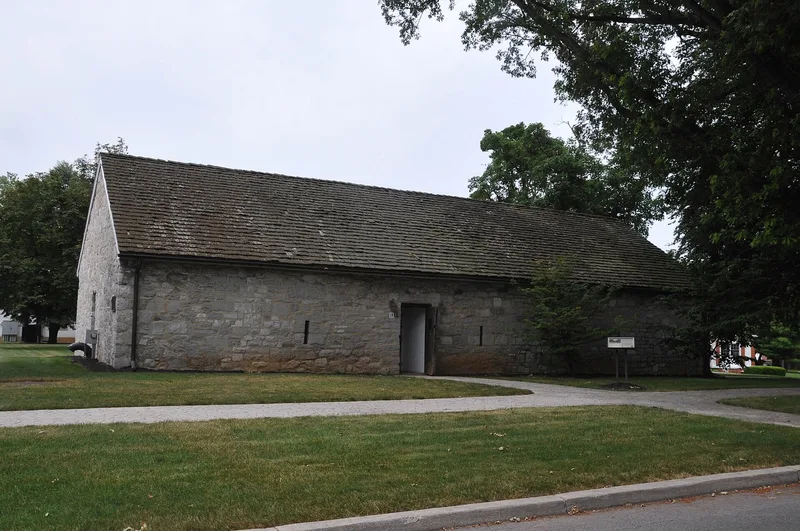
Built in 1777 as a powder magazine at Carlisle Barracks, this stone building measures 70 by 32 feet, with walls four and one-half feet thick lined with brick inside and a vaulted stone roof. Its interior is divided into three main rooms, with four solitary cells at the west end. Continental Congress resolutions called for a magazine at Carlisle to hold 10,000 stands of arms and 200 tons of gunpowder, and General Washington later sent powder from Baltimore to the site. Local tradition holds that Hessian prisoners captured at Trenton built it, though the form assumes this from a Congressional order putting 40 prisoners to work at the post. The building later served as a guardhouse, where Carlisle Indian School students were held for drunkenness, and it gave the site its name, the Hessian Guardhouse. It was opened to the public as a museum on Army Day in 1948.
Significance in brief: The nomination argues the building dates to 1777, when the Continental Congress had a magazine built at Carlisle to store arms and gunpowder after the British threat to eastern seacoast towns. It is associated with Hessian prisoners of war, who are said to have built it, and it later served as a guardhouse, including for Carlisle Indian School students. It is also described as an embodiment of military tradition and a repository of relics from the Cumberland Valley's history.
Machine-generated summary. This summary was generated by a language model from the official nomination document and has not been reviewed line by line by an editor. It may contain errors. Check the source document before relying on any detail. Source: nomination document (PDF) · National Archives catalog entry. NRHP reference 74001778, listed May 17, 1974. Summary generated October 2026 (model claude-haiku-5-5, prompt v1.1-2026-10-29, confidence medium).
Key facts
| Address | Guardhouse and Garrison Lanes, Carlisle |
|---|---|
| County | Cumberland County |
| Listed | May 17, 1974 |
| Reference number | 74001778 |
| Resource type | Building |
| Period of significance | 1777 |
| Areas of significance | Historic - Non-Aboriginal, Military, Architecture |
| Level of significance | National |
| Status (as stated in the nomination) | Used as a museum; some original features such as the chimney, ventilators and covered east porch have been removed. |
| Acreage | 0.2 |
| Coordinates | 40.19801, -77.17808 (NPS GIS) |
What listing means for this property
National Register listing is honorary: it recognises significance and does not restrict what a private owner may do without federal money or permits. It unlocks the 20% federal rehabilitation tax credit for income-producing buildings, state credits in many states, and Section 106 review when federal agencies are involved. See what listing means in practice.
General information, not legal or tax advice. Rules change; confirm with your State Historic Preservation Office or a qualified adviser.
Sources and further reading
- National Park Service, National Register of Historic Places database (snapshot May 2026), reference 74001778.
- Nomination form (PDF, National Archives) — catalog entry
- Wikipedia article (used for cross-checking only; text not reproduced here)
- Wikidata Q5746222
- This listing as JSON
Last updated October 2026. Found an error? See the editorial policy for how to report it.