Embreeville Historic District

Why it's listed
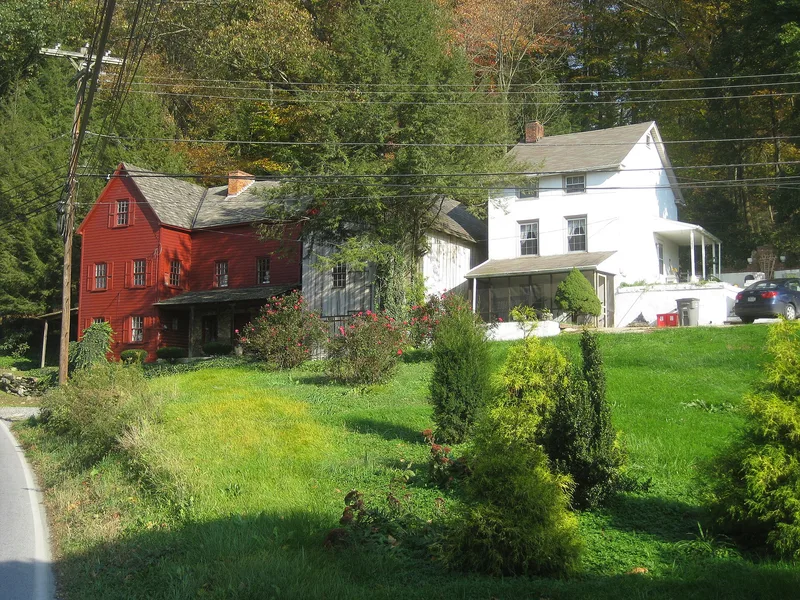
Twelve principal buildings on both banks of the West Branch Brandywine River in Newlin Township make up the Embreeville Historic District. Most are stuccoed or locally quarried stone, two to two-and-a-half stories high, with plain gable roofs and end chimneys, many banked into hillsides above the river. The earliest building, house number 12, dates from about 1760, and the mill, with a stone core, dates from about 1750. A 1756 deed records a grist and saw mill here, and in 1871 James Trimble held it. The village of Old Embreeville was built between 1822 and 1842 by William Embree, a brewer, malster and storekeeper of Huguenot descent. The district is significant for its milling complex and village that remain largely intact from the 18th and 19th centuries, and for the mill's 1880s conversion to roller milling. In 1966 the mill was described as the sole surviving water-powered mill on the Brandywine.
Significance in brief: The district is significant for its surviving 18th- and 19th-century milling and village development along the Brandywine, with buildings that remain largely unaltered and retain a clear sense of the early village. Its mill, which originated in the 18th century, is described as the sole surviving water-powered mill on the Brandywine, and the village is linked to the William Embree family and to the regional economy of the Brandywine corridor.
Machine-generated summary. This summary was generated by a language model from the official nomination document and has not been reviewed line by line by an editor. It may contain errors. Check the source document before relying on any detail. Source: nomination document (PDF) · National Archives catalog entry. NRHP reference 85002350, listed September 16, 1985. Summary generated October 2026 (model claude-haiku-5-5, prompt v1.1-2026-10-29, confidence high).
Key facts
| Address | Rt. 162, Newlin Twp. |
|---|---|
| County | Chester County |
| Listed | September 16, 1985 |
| Reference number | 85002350 |
| Resource type | District |
| Period of significance | 1700-1899 |
| Criteria |
|
| Areas of significance | Industry, Commerce |
| Level of significance | Local |
| Status (as stated in the nomination) | Most buildings are in good condition with few exterior alterations; the mill was still operable at the time of the nomination. |
| Acreage | 65 |
| Coordinates | 39.92506, -75.73159 (NPS GIS) |
What listing means for this property
This is a historic district. Buildings within its boundary are either contributing (they add to the district's significance) or non-contributing. Owners of contributing income-producing buildings can claim the 20% federal rehabilitation tax credit; homeowners should look at state credits. National Register districts impose no design review by themselves; a local historic district ordinance, if one exists, does (the difference explained).
General information, not legal or tax advice. Rules change; confirm with your State Historic Preservation Office or a qualified adviser.
Sources and further reading
- National Park Service, National Register of Historic Places database (snapshot May 2026), reference 85002350.
- Nomination form (PDF, National Archives) — catalog entry
- Wikipedia article (used for cross-checking only; text not reproduced here)
- Wikidata Q5370181
- This listing as JSON
Last updated October 2026. Found an error? See the editorial policy for how to report it.