Dilworthtown Historic District
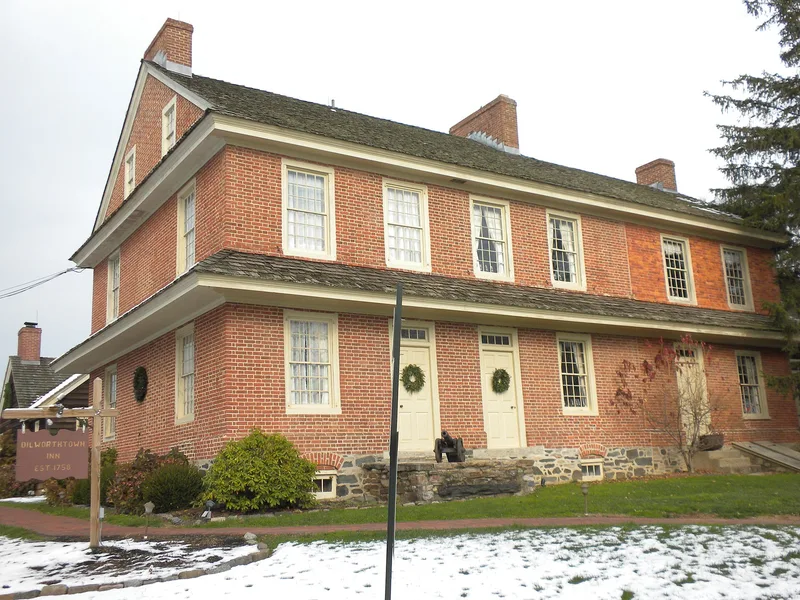

Why it's listed
Dilworthtown is a small hamlet in Chester County, Pennsylvania, anchored by the Dilworth House, a red brick Flemish bond residence built in 1758 for blacksmith James Dilworth. From the last quarter of the eighteenth century it operated as the Dilworthtown Inn, and later additions enlarged it to a six bay front. Around it stand two early nineteenth century stone houses, two mid-nineteenth century stone tenant houses, a store completed in 1858, and a wood frame lyceum built over a blacksmith's shop. The village is said to have supplied tires for the wagons of Braddock's expedition during the French and Indian War, and it suffered damage from British troops after the Battle of the Brandywine in 1777. Its tavern, blacksmith shop, store and meeting hall made it a community centre, and it has changed little since the early twentieth century.
Significance in brief: The nomination argues that the village is significant for its architecture and its community role, centred on the Dilworth House, which it describes as one of the most significant structures in the Delaware Valley. Its tavern, blacksmith shop, store and lyceum reflect its role as a crossroads community, and its roughly unchanged appearance is cited as a reason for its significance. The text also links the village to Braddock's expedition and to damage during the Battle of the Brandywine.
Machine-generated summary. This summary was generated by a language model from the official nomination document and has not been reviewed line by line by an editor. It may contain errors. Check the source document before relying on any detail. Source: nomination document (PDF) · National Archives catalog entry. NRHP reference 73001601, listed January 18, 1973. Summary generated October 2026 (model claude-haiku-5-5, prompt v1.1-2026-10-29, confidence medium).
Key facts
| Address | Jct. of CR 15199 and 15087, Dilworthtown |
|---|---|
| County | Chester County |
| Listed | January 18, 1973 |
| Reference number | 73001601 |
| Resource type | District |
| Period of significance | 1700-1899 |
| Criteria |
|
| Areas of significance | Commerce, Military, Architecture |
| Level of significance | National |
| Status (as stated in the nomination) | Condition is marked as fair; the lyceum is in exceedingly poor condition, the log cabin is rapidly deteriorating and the stone house has deteriorated, while the cabin is used for storage. |
| Acreage | 15 |
| Within district | Brandywine Battlefield |
| Coordinates | 39.89932, -75.56804 (NPS GIS) |
What listing means for this property
This is a historic district. Buildings within its boundary are either contributing (they add to the district's significance) or non-contributing. Owners of contributing income-producing buildings can claim the 20% federal rehabilitation tax credit; homeowners should look at state credits. National Register districts impose no design review by themselves; a local historic district ordinance, if one exists, does (the difference explained).
General information, not legal or tax advice. Rules change; confirm with your State Historic Preservation Office or a qualified adviser.
Sources and further reading
- National Park Service, National Register of Historic Places database (snapshot May 2026), reference 73001601.
- Nomination form (PDF, National Archives) — catalog entry
- Wikipedia article (used for cross-checking only; text not reproduced here)
- Wikidata Q5277102
- This listing as JSON
Last updated October 2026. Found an error? See the editorial policy for how to report it.