Log House, Hiester House, and Market Annex

Why it's listed
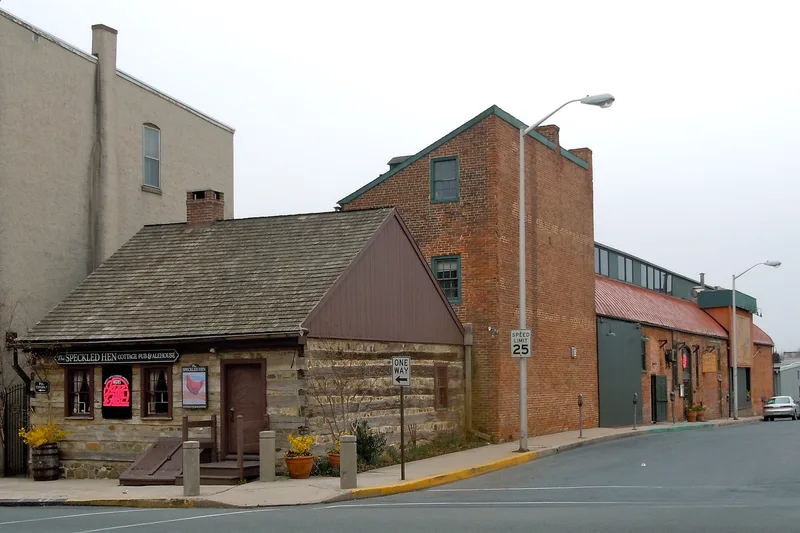
Three buildings on one corner lot in central Reading stand as a record of how the town's building changed between the 1760s and 1895. The oldest is a 1½-storey log house, built as a dwelling of notched pine logs with a stone-and-mortar chinking on a lot granted in 1752, and its hand-hewn summer beam and pegged rafters survive. Around the early 1820s a two-bay brick house of Reading-made brick was built directly behind it, and the two were linked at two levels. The third building, a market annex erected in 1895, uses laminated wood trusses in a near-circular profile with a brick west end and a frame east end. The complex reflects the lot's move from residence to commercial use, and its log, brick and trussed structures show three distinct building traditions side by side.
Significance in brief: The nomination argues that the three contiguous buildings, each from a different period, illustrate a century and a half of architectural change and progressive sophistication in Reading's builders, and that they survived largely unaltered despite urban development. The property also shows the gradual shift of the lot from residential to commercial use.
Machine-generated summary. This summary was generated by a language model from the official nomination document and has not been reviewed line by line by an editor. It may contain errors. Check the source document before relying on any detail. Source: nomination document (PDF) · National Archives catalog entry. NRHP reference 79002169, listed November 20, 1979. Summary generated October 2026 (model claude-haiku-5-5, prompt v1.1-2026-10-29, confidence medium).
Key facts
| Address | 30 S. 4th St., Reading |
|---|---|
| County | Berks County |
| Listed | November 20, 1979 |
| Reference number | 79002169 |
| Resource type | Building |
| Period of significance | 1760-1895 |
| Areas of significance | Commerce, Architecture |
| Level of significance | Local |
| Acreage | 0.9 |
| Coordinates | 40.33424, -75.92990 (NPS GIS) |
What listing means for this property
National Register listing is honorary for a privately owned home: it does not by itself restrict what an owner may do with their own money, and it does not require public access. Restrictions come from local landmark or historic-district ordinances, which are separate (how they differ).
Owner-occupied houses are not eligible for the 20% federal rehabilitation tax credit, which applies to income-producing buildings, but many states offer credits for homeowners. Listing also opens the door to preservation easements and to buying a plaque. Start with what listing means for homeowners, renovating a listed house and selling one.
General information, not legal or tax advice. Rules change; confirm with your State Historic Preservation Office or a qualified adviser.
Sources and further reading
- National Park Service, National Register of Historic Places database (snapshot May 2026), reference 79002169.
- Nomination form (PDF, National Archives) — catalog entry
- Wikipedia article (used for cross-checking only; text not reproduced here)
- Wikidata Q6666808
- This listing as JSON
Last updated October 2026. Found an error? See the editorial policy for how to report it.