Trinity Lutheran Church

Why it's listed
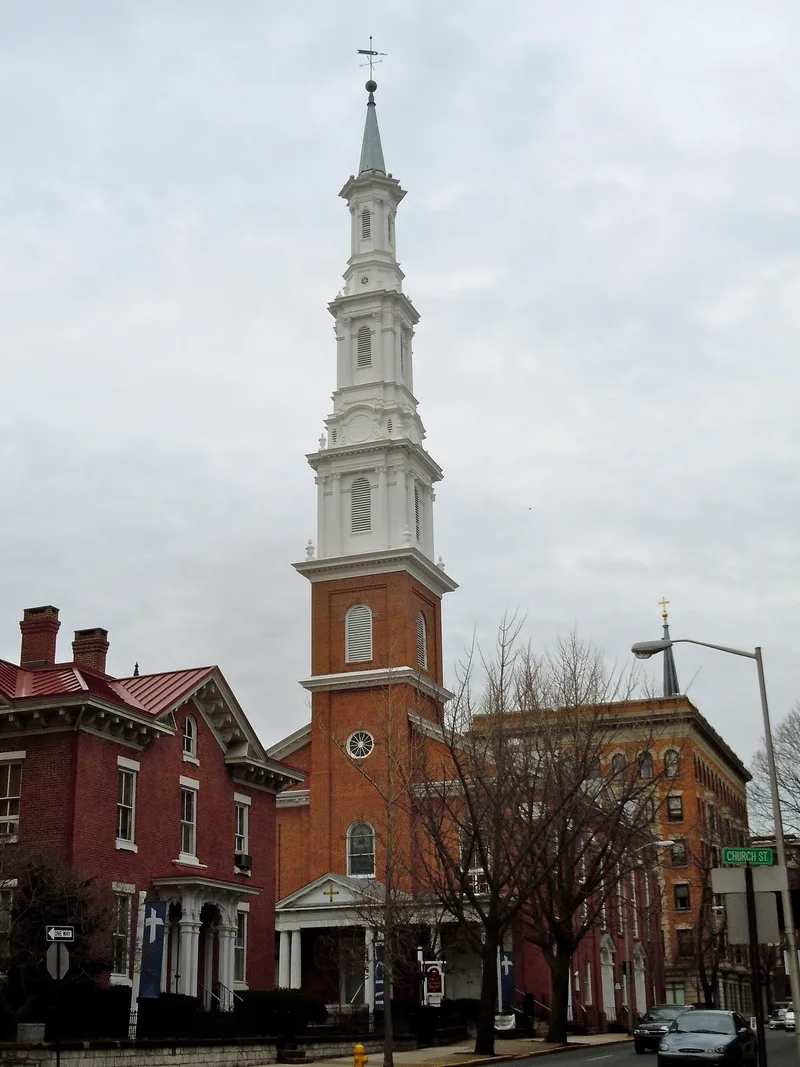
Built of red brick in Flemish bond between 1792 and 1794, Trinity Lutheran Church in Reading has five bays along its length, two stories in height, and arched multipaned windows with keystones. Its two symmetrical entrances have fanlights, fluted pilasters and gables, and a square bell tower stands at the west end. The congregation was founded in 1751, and the church is the oldest Lutheran church in the city. Frederick A. Muhlenberg, twice speaker of the Continental Congress, and his son Henry A. Muhlenberg, later U.S. Ambassador to Austria, served as pastors here. In 1838 the church hosted an Anti-Masonic party convention that nominated Joseph Ritner for governor. The adjoining cemetery holds graves of Revolutionary War soldiers, including Dr. Bodo Otto, chief physician at Valley Forge. The building is regarded as a good example of Georgian architecture.
Significance in brief: The nomination describes the church as the first and leading Lutheran church in the Reading area and the oldest congregation of any denomination in the city, founded in 1751. It is cited as a good example of Georgian architecture and as the site of a political convention in 1838 that nominated Joseph Ritner for governor. The cemetery contains graves of Revolutionary War soldiers, including Dr. Bodo Otto.
Machine-generated summary. This summary was generated by a language model from the official nomination document and has not been reviewed line by line by an editor. It may contain errors. Check the source document before relying on any detail. Source: nomination document (PDF) · National Archives catalog entry. NRHP reference 76001603, listed June 7, 1976. Summary generated October 2026 (model claude-haiku-5-5, prompt v1.1-2026-10-29, confidence medium).
Key facts
| Address | 6th and Washington Sts., Reading |
|---|---|
| County | Berks County |
| Listed | June 7, 1976 |
| Reference number | 76001603 |
| Resource type | Building |
| Period of significance | 1700-1799 |
| Architectural style | Georgian |
| Criteria |
|
| Areas of significance | Politics/Government, Architecture, Religion |
| Level of significance | Local |
| Acreage | 0.9 |
| Coordinates | 40.33715, -75.92606 (NPS GIS) |
What listing means for this property
Religious properties are listed for their architectural or historical significance, not their religious use. Listing is honorary and does not restrict the congregation's use of the building. The federal rehabilitation credit is generally unavailable unless part of the building is income-producing; some state programmes and preservation grants do cover religious buildings. Federal funding or permits trigger Section 106 review.
General information, not legal or tax advice. Rules change; confirm with your State Historic Preservation Office or a qualified adviser.
Sources and further reading
- National Park Service, National Register of Historic Places database (snapshot May 2026), reference 76001603.
- Nomination form (PDF, National Archives) — catalog entry
- Wikipedia article (used for cross-checking only; text not reproduced here)
- Wikidata Q7842881
- This listing as JSON
Last updated October 2026. Found an error? See the editorial policy for how to report it.