Grimshaw Silk Mill
Also known as: Freeman Shoes

Why it's listed
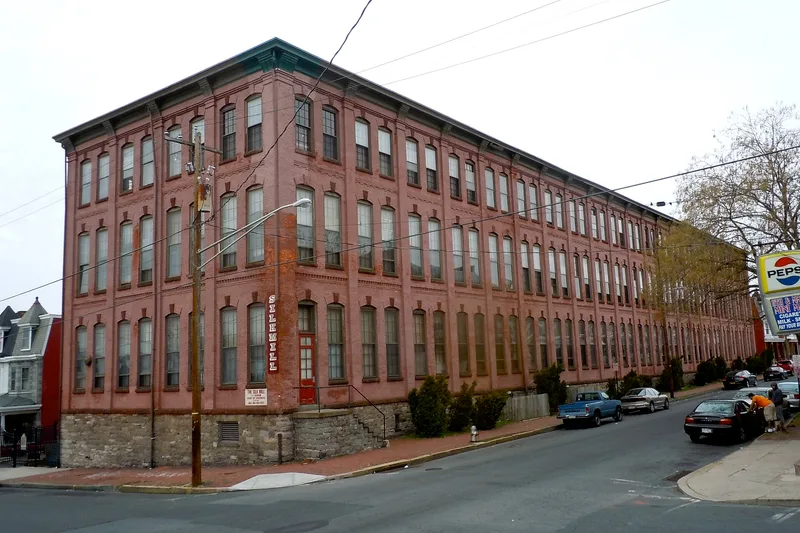
A large brick mill on 11th Street in Reading, Pennsylvania, the Grimshaw Silk Mill is roughly 250 feet long and 50 feet wide, with a rubble stone basement and pilasters rising to a pressed metal cornice. The mill was financed by Reading citizens and run with machinery and management supplied by the Grimshaw Brothers of Paterson, New Jersey, and it employed several hundred young women in spinning and weaving. A windstorm destroyed the first building in January 1889, killing seventeen workers and injuring about one hundred, and the replacement was built by Reading contractor L.H. Focht. The nomination regards the rebuilt mill as one of the most elaborately styled mill buildings in the region. Its survival in a residential neighborhood illustrates how work and housing were closely linked in nineteenth-century American cities.
Significance in brief: The nomination argues the mill marks the extension of the Paterson, New Jersey silk trade into smaller American cities, financed by local citizens. Its 1889 reconstruction followed a windstorm disaster that killed seventeen women workers, and its articulated brickwork and cornices are described as an unusually sophisticated example of late nineteenth-century mill architecture.
Machine-generated summary. This summary was generated by a language model from the official nomination document and has not been reviewed line by line by an editor. It may contain errors. Check the source document before relying on any detail. Source: nomination document (PDF) · National Archives catalog entry. NRHP reference 85000176, listed January 31, 1985. Summary generated October 2026 (model claude-haiku-5-5, prompt v1.1-2026-10-29, confidence medium).
Key facts
| Address | 1200 N. 1100 St., Reading |
|---|---|
| County | Berks County |
| Listed | January 31, 1985 |
| Reference number | 85000176 |
| Resource type | Building |
| Period of significance | 1800-1899 |
| Architect / builder | L.H. Focht (builder/contractor) |
| Criteria |
|
| Areas of significance | Industry, Architecture |
| Level of significance | Local |
| Status (as stated in the nomination) | The document states the building survives in excellent condition. |
| Acreage | 0.5 |
| Coordinates | 40.35282, -75.91567 (NPS GIS) |
What listing means for this property
For an income-producing building, listing (individually or as a contributing building in a district) is the gateway to the 20% federal rehabilitation tax credit on qualified rehabilitation costs, often stackable with state credits. Work claiming the credit must follow the Secretary of the Interior's Standards and be approved in advance.
Listing does not restrict a private owner acting without federal money or permits; where federal funding or licensing is involved, Section 106 review applies.
General information, not legal or tax advice. Rules change; confirm with your State Historic Preservation Office or a qualified adviser.
Sources and further reading
- National Park Service, National Register of Historic Places database (snapshot May 2026), reference 85000176.
- Nomination form (PDF, National Archives) — catalog entry
- Wikipedia article (used for cross-checking only; text not reproduced here)
- Wikidata Q5609341
- This listing as JSON
Last updated October 2026. Found an error? See the editorial policy for how to report it.