Merrick Art Gallery

Why it's listed
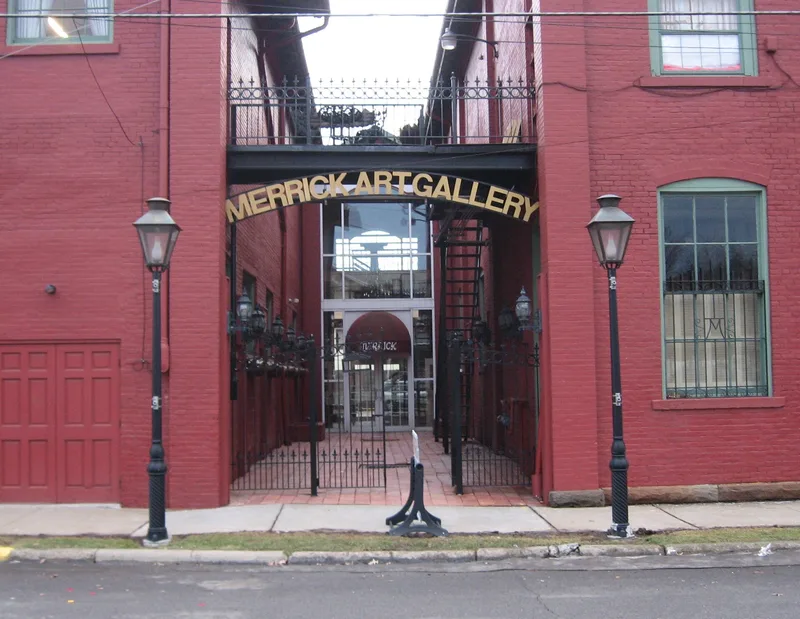
Two brick buildings on a corner lot in New Brighton, Pennsylvania, form the Merrick Art Gallery. The eastern section began as a one-story railroad station around 1850, which Edward Dempster Merrick bought in 1880 and converted to display space, adding a second floor in 1884. A two-story south addition followed in 1888, and a separate brick gallery building to the west was completed in 1901 with a skylit second-floor gallery finished entirely in wood. Merrick, a native of New Brighton and a manufacturer, was a painter and collector who focused on eighteenth and nineteenth century paintings by American, English, French and German artists. The collection of over 240 paintings includes works by Thomas Sully, Gustave Courbet and Asher B. Durand. The gallery opened to the public free of charge and offered art instruction, and it is regarded as the first cultural institution of its kind in western Pennsylvania, predating Pittsburgh's Carnegie Institute by about ten years.
Significance in brief: The nomination argues the gallery was an early private museum in Western Pennsylvania, predating Pittsburgh's Carnegie Institute by 10 years, and the first cultural institution in the region open to the public free of charge. It is also significant as a philanthropic gift by Edward Dempster Merrick, and the 1901 principal gallery space is described as one of the few unaltered turn-of-the-century gallery spaces in the Commonwealth.
Machine-generated summary. This summary was generated by a language model from the official nomination document and has not been reviewed line by line by an editor. It may contain errors. Check the source document before relying on any detail. Source: nomination document (PDF) · National Archives catalog entry. NRHP reference 83002215, listed August 5, 1983. Summary generated October 2026 (model claude-haiku-5-5, prompt v1.1-2026-10-29, confidence medium).
Key facts
| Address | 5th Ave. and 11th St., New Brighton |
|---|---|
| County | Beaver County |
| Listed | August 5, 1983 |
| Reference number | 83002215 |
| Resource type | Building |
| Period of significance | c. 1850-1901 |
| Architectural style | Greek Revival railroad station adapted to late Victorian gallery use |
| Criteria |
|
| Areas of significance | Art, Architecture, Social History |
| Level of significance | Local |
| Status (as stated in the nomination) | Altered over time; the first floor of the 1901 gallery was used by a library and a modern vestibule was added in the 1950s, with plans in progress to remove it; the collection is still displayed as envisioned by its founder. |
| Acreage | 0.4 |
| Coordinates | 40.73311, -80.31056 (NPS GIS) |
What listing means for this property
National Register listing is honorary: it recognises significance and does not restrict what a private owner may do without federal money or permits. It unlocks the 20% federal rehabilitation tax credit for income-producing buildings, state credits in many states, and Section 106 review when federal agencies are involved. See what listing means in practice.
General information, not legal or tax advice. Rules change; confirm with your State Historic Preservation Office or a qualified adviser.
Sources and further reading
- National Park Service, National Register of Historic Places database (snapshot May 2026), reference 83002215.
- Nomination form (PDF, National Archives) — catalog entry
- Wikipedia article (used for cross-checking only; text not reproduced here)
- Wikidata Q16895043
- This listing as JSON
Last updated October 2026. Found an error? See the editorial policy for how to report it.