Bridgewater Historic District
Also known as: Sharon; W. Bridgewater; See Also:William Dunlap Mansion

Why it's listed
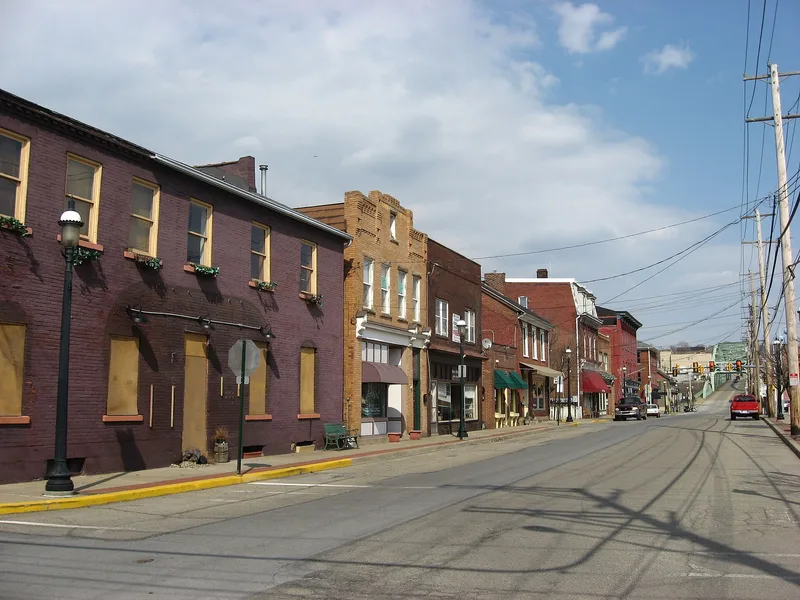
Bridgewater is a river borough of roughly two or three blocks wide, laid out in 1818 on a narrow flat site between the Beaver River and a bluff at the confluence with the Ohio. Its historic district holds 97 contributing buildings and the Bridgewater Bridge, which opened in 1933, along with a canal lock and submerged dam. The district developed as a transfer point where canal boats and river steamboats exchanged cargo after the Beaver Division of the Erie Extension Canal reached the Ohio in 1834. Bridge Street, lined with brick commercial buildings from the Greek Revival and Italianate periods, became the main business street. Market Street holds mostly two-story wood-frame houses built between the 1890s and 1920s, including Queen Anne and Craftsman examples. The William Dunlap Mansion and the Davidson House, both built around 1840, are the most prominent Greek Revival houses in the district.
Significance in brief: The nomination argues the district is significant for its succession of transportation systems, including the rivers, the Erie Extension Canal and the Beaver River bridge, which drove the borough's economic and physical development. It also argues the district has architectural value through its collection of Greek Revival and Queen Anne buildings dating from 1818 to 1933.
Machine-generated summary. This summary was generated by a language model from the official nomination document and has not been reviewed line by line by an editor. It may contain errors. Check the source document before relying on any detail. Source: nomination document (PDF) · National Archives catalog entry. NRHP reference 96000713, listed June 28, 1996. Summary generated October 2026 (model claude-haiku-5-5, prompt v1.1-2026-10-29, confidence medium).
Key facts
| Address | Roughly bounded by Bridge St., Mulberry St., Fulton St., Cherry Alley, Elm St., and Beaver River, Bridgewater |
|---|---|
| County | Beaver County |
| Listed | June 28, 1996 |
| Reference number | 96000713 |
| Resource type | District |
| Period of significance | 1818-1933 |
| Architectural style | Greek Revival; Italianate; Queen Anne; Colonial Revival; Craftsman |
| Criteria |
|
| Areas of significance | Transportation, Architecture, Commerce |
| Level of significance | Local |
| Acreage | 72.1 |
| Coordinates | 40.70339, -80.29511 (NPS GIS) |
What listing means for this property
This is a historic district. Buildings within its boundary are either contributing (they add to the district's significance) or non-contributing. Owners of contributing income-producing buildings can claim the 20% federal rehabilitation tax credit; homeowners should look at state credits. National Register districts impose no design review by themselves; a local historic district ordinance, if one exists, does (the difference explained).
General information, not legal or tax advice. Rules change; confirm with your State Historic Preservation Office or a qualified adviser.
Sources and further reading
- National Park Service, National Register of Historic Places database (snapshot May 2026), reference 96000713.
- Nomination form (PDF, National Archives) — catalog entry
- Wikipedia article (used for cross-checking only; text not reproduced here)
- Wikidata Q4966845
- This listing as JSON
Last updated October 2026. Found an error? See the editorial policy for how to report it.