Woods, John, House

Why it's listed
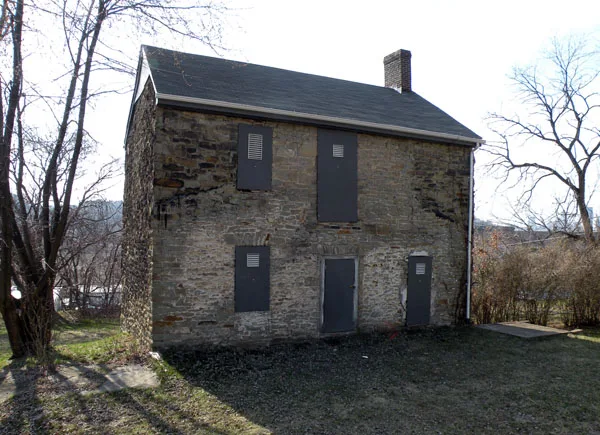
Built around 1792 of rubblestone with large quoins at the corners, this two-and-a-half-story, three-bay house stands on a bluff above the Monongahela River in Hazlewood, Pittsburgh. Its stone walls, banked into the slope, were unusual in a city where brick was favored by the commercial elite. The 1798 federal tax assessment recorded a stone house of about 24 by 30 feet with ten windows at this site, and it was owned by James O'Hara, an army quartermaster and pioneering manufacturer. John Woods, a lawyer and member of a prominent Pittsburgh family, later lived in the house and was involved in the political events of the Whiskey Rebellion. A mid-19th-century frame addition with Greek Revival detailing was built on the east side. The house is regarded as a rare survivor of late 18th-century vernacular building in Pittsburgh, and the Hazlewood section it occupies has long been industrial and residential in character.
Significance in brief: The nomination argues the house is a rare surviving late 18th-century vernacular stone house in Pittsburgh, one of very few 18th-century buildings remaining in the city. It is associated with John Woods, a lawyer and political figure who took part in the Whiskey Rebellion era, and with James O'Hara, a federal army quartermaster and early manufacturer who owned the house in 1798. Its stone construction and size are presented as unusual for the period.
Machine-generated summary. This summary was generated by a language model from the official nomination document and has not been reviewed line by line by an editor. It may contain errors. Check the source document before relying on any detail. Source: nomination document (PDF) · National Archives catalog entry. NRHP reference 93000353, listed April 29, 1993. Summary generated October 2026 (model claude-haiku-5-5, prompt v1.1-2026-10-29, confidence medium).
Key facts
| Address | 4604 Monongahela St., Pittsburgh |
|---|---|
| County | Allegheny County |
| Listed | April 29, 1993 |
| Reference number | 93000353 |
| Resource type | Building |
| Period of significance | C. 1792-1798 |
| Architectural style | Vernacular |
| Areas of significance | Politics/Government, Architecture |
| Level of significance | Local |
| Status (as stated in the nomination) | The house is currently vacant and in deteriorated condition. |
| Acreage | 0.3 |
| Coordinates | 40.41486, -79.94466 (NPS GIS) |
What listing means for this property
National Register listing is honorary for a privately owned home: it does not by itself restrict what an owner may do with their own money, and it does not require public access. Restrictions come from local landmark or historic-district ordinances, which are separate (how they differ).
Owner-occupied houses are not eligible for the 20% federal rehabilitation tax credit, which applies to income-producing buildings, but many states offer credits for homeowners. Listing also opens the door to preservation easements and to buying a plaque. Start with what listing means for homeowners, renovating a listed house and selling one.
Noted as vacant in the nomination. Nomination documents can be decades old; current status may differ. If you are considering buying an empty listed property, read the due-diligence checklist.
General information, not legal or tax advice. Rules change; confirm with your State Historic Preservation Office or a qualified adviser.
Sources and further reading
- National Park Service, National Register of Historic Places database (snapshot May 2026), reference 93000353.
- Nomination form (PDF, National Archives) — catalog entry
- Wikipedia article (used for cross-checking only; text not reproduced here)
- Wikidata Q6264842
- This listing as JSON
Last updated October 2026. Found an error? See the editorial policy for how to report it.