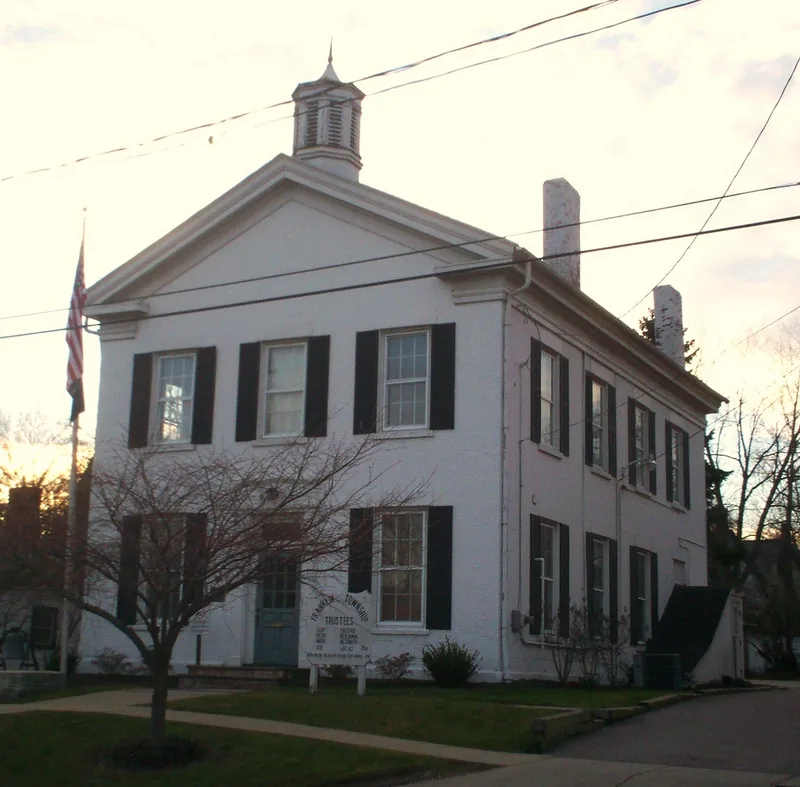
Franklin Township Hall

Why it's listed
Franklin Township Hall is a two-story, three-bay brick building on Gougler Avenue in Kent, Ohio, painted white and fitted with green-shuttered six-over-six windows. Planned in 1836 as headquarters for the Franklin Company, its construction halted when local alpaca mills failed in the Panic of 1837. The township took it over and finished it as a town hall. Zenas Kent, a locally prominent builder, served as architect, Fredrick Wadsworth as contractor, and Nathan Button designed the open curving stair, the only original interior feature to survive a serious fire. The hall served the township from 1840 to 1867, housed a school in 1842, and hosted the village's first Roman Catholic services in 1851. In 1859 James A. Garfield was nominated there as an Ohio Senator, launching his political career. Kent State College used it as a summer school from 1901 to 1936, and the city school board has used it for offices since 1954. Greek Revival proportions mark the design, though the entry and cupola were altered.
Significance in brief: The nomination calls the well-preserved building important to Franklin Township and the City of Kent. It was planned as headquarters for the Franklin Company, then completed by the township after the Panic of 1837. It later hosted school classes, early Catholic services and James A. Garfield's 1859 nomination as an Ohio Senator.
Machine-generated summary. This summary was generated by a language model from the official nomination document and has not been reviewed line by line by an editor. It may contain errors. Check the source document before relying on any detail. Source: nomination document (PDF) · National Archives catalog entry. NRHP reference 75001525, listed October 10, 1975. Summary generated October 2026 (model claude-sonnet-5-5, prompt v1.0-2026-10-29, confidence medium).
Key facts
| Address | 218 Gougler Ave., Kent |
|---|---|
| County | Portage County |
| Listed | October 10, 1975 |
| Reference number | 75001525 |
| Resource type | Building |
| Period of significance | 1837 |
| Architect / builder | Zenas Kent (architect); Fredrick Wadsworth (contractor); Nathan Button designed the curving stair |
| Architectural style | Greek Revival |
| Areas of significance | Social History |
| Level of significance | Local |
| Status (as stated in the nomination) | Listed in good condition and occupied; since 1954 it has housed executive offices for the Kent city board of education, with the township trustees named as owners. |
| Acreage | 0.9 |
| Coordinates | 41.15520, -81.36035 (NPS GIS) |
What listing means for this property
National Register listing is honorary for a privately owned home: it does not by itself restrict what an owner may do with their own money, and it does not require public access. Restrictions come from local landmark or historic-district ordinances, which are separate (how they differ).
Owner-occupied houses are not eligible for the 20% federal rehabilitation tax credit, which applies to income-producing buildings, but many states offer credits for homeowners. Listing also opens the door to preservation easements and to buying a plaque. Start with what listing means for homeowners, renovating a listed house and selling one.
General information, not legal or tax advice. Rules change; confirm with your State Historic Preservation Office or a qualified adviser.
Sources and further reading
- National Park Service, National Register of Historic Places database (snapshot May 2026), reference 75001525.
- Nomination form (PDF, National Archives) — catalog entry
- Wikipedia article (used for cross-checking only; text not reproduced here)
- Wikidata Q5492056
- This listing as JSON
Last updated October 2026. Found an error? See the editorial policy for how to report it.