Newton, Judge Eben, House

Why it's listed
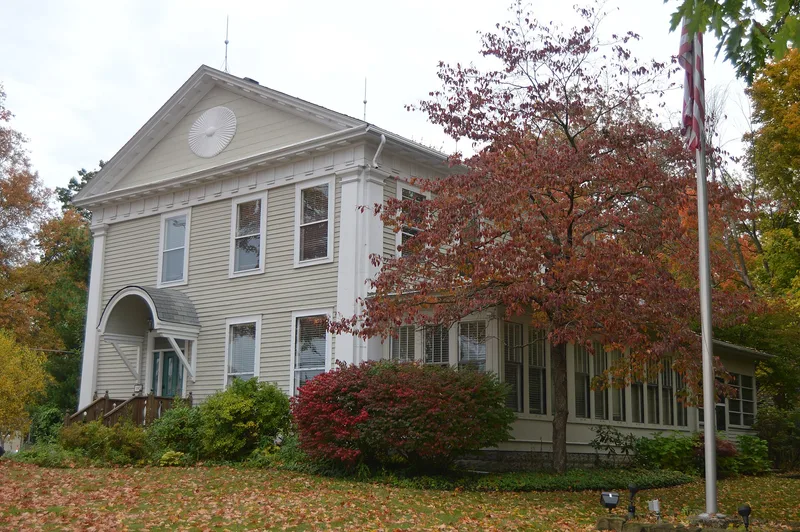
This large two-story frame house at 105 North Broad Street in Canfield, Ohio, is traditionally dated to 1826. It was the home of Judge Eben Newton, a Connecticut-born lawyer who formed a partnership with Elisha Whittlesey in 1822, served as a state senator in 1842, and became the first presiding judge when Canfield was made seat of the new Mahoning County in 1846. He donated land for the county buildings and later gave the old courthouse to the North Eastern Ohio Normal College in 1881. The house is a rectangular block altered over time in several classical styles. Its facade has a sunburst in the pediment, a Federal-period variation on the fanlight. The parlor retains slender Ionic columns, arches, and a mantel frieze with Adamesque urns. The stairhall was remodeled in the mid-nineteenth century, while the kitchen and dining areas have been remodeled. It is now a restaurant.
Significance in brief: The nomination argues the house was the home of one of the most important and influential citizens of nineteenth-century Canfield. It is also a good example of a late Federal period house, with notable interior woodwork. Despite alterations, it still gives a picture of an important citizen in a small county seat in the mid-nineteenth century.
Machine-generated summary. This summary was generated by a language model from the official nomination document and has not been reviewed line by line by an editor. It may contain errors. Check the source document before relying on any detail. Source: nomination document (PDF) · National Archives catalog entry. NRHP reference 74001562, listed July 18, 1974. Summary generated October 2026 (model claude-sonnet-5-5, prompt v1.0-2026-10-29, confidence high).
Key facts
| Address | 105 N. Broad St., Canfield |
|---|---|
| County | Mahoning County |
| Listed | July 18, 1974 |
| Reference number | 74001562 |
| Resource type | Building |
| Period of significance | 19th Century (specific date 1826?) |
| Architectural style | Late Federal period, with later alterations in various classical styles |
| Areas of significance | Politics/Government, Architecture |
| Level of significance | Local |
| Status (as stated in the nomination) | Described as in excellent condition and altered, on its original site; used as a restaurant at the time of nomination. |
| Acreage | 0.9 |
| Coordinates | 41.02769, -80.76012 (NPS GIS) |
What listing means for this property
National Register listing is honorary for a privately owned home: it does not by itself restrict what an owner may do with their own money, and it does not require public access. Restrictions come from local landmark or historic-district ordinances, which are separate (how they differ).
Owner-occupied houses are not eligible for the 20% federal rehabilitation tax credit, which applies to income-producing buildings, but many states offer credits for homeowners. Listing also opens the door to preservation easements and to buying a plaque. Start with what listing means for homeowners, renovating a listed house and selling one.
General information, not legal or tax advice. Rules change; confirm with your State Historic Preservation Office or a qualified adviser.
Sources and further reading
- National Park Service, National Register of Historic Places database (snapshot May 2026), reference 74001562.
- Nomination form (PDF, National Archives) — catalog entry
- Wikidata Q138561825
- This listing as JSON
Last updated October 2026. Found an error? See the editorial policy for how to report it.