Lutz's Tavern
Also known as: Rider Tavern
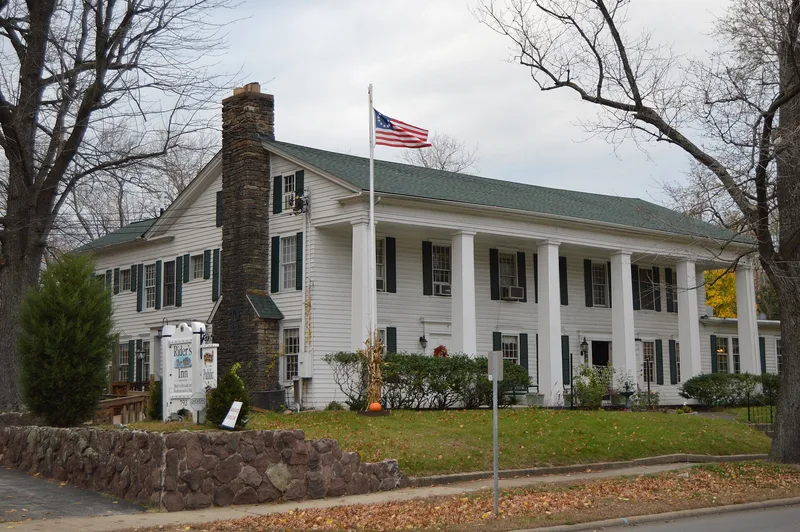

Why it's listed
Lutz's Tavern, originally the Rider Tavern, stands at 792 Mentor Avenue in Painesville, Ohio. It began in 1818 as a small one-story stagecoach stop on the early road between Buffalo and Cleveland, built by Joseph Rider, one of the earliest settlers in the Lake County area. In 1832 Jonathan Goldsmith, described as the county's most famous builder, added a second floor and giant square Doric columns supporting the overhanging roof. The timber-frame building has clapboard siding, a stone foundation and a gable roof. It was converted to a residence in 1865, and later changes included a remodeled west end in 1913, a dining room added in 1922, and aluminum siding. The tavern is significant as a surviving stagecoach stop and as one of only a handful of remaining examples of Goldsmith's Federal and Greek Revival work in the Western Reserve. Railroads reduced travel on the road in the 1850s and 1860s, but automobile traffic later brought travelers back.
Significance in brief: It was one of many stagecoach stops along the early Cleveland-Buffalo road. It was built by early settler Joseph Rider. It was remodeled in 1832 by Jonathan Goldsmith, Lake County's most noted builder, and is one of a handful of surviving examples of his Federal and Greek Revival work in the Western Reserve.
Machine-generated summary. This summary was generated by a language model from the official nomination document and has not been reviewed line by line by an editor. It may contain errors. Check the source document before relying on any detail. Source: nomination document (PDF) · National Archives catalog entry. NRHP reference 73001487, listed April 23, 1973. Summary generated October 2026 (model claude-sonnet-5-5, prompt v1.0-2026-10-29, confidence medium).
Key facts
| Address | 792 Mentor Ave., Painesville |
|---|---|
| County | Lake County |
| Listed | April 23, 1973 |
| Reference number | 73001487 |
| Resource type | Building |
| Period of significance | 1810-1818 (alteration by Goldsmith in 1832) |
| Architect / builder | Joseph Rider (builder); Jonathan Goldsmith (1832 remodeling) |
| Architectural style | Federal and Greek Revival |
| Areas of significance | Architecture |
| Level of significance | Local |
| Status (as stated in the nomination) | Listed in excellent condition and marked altered, on its original site; the form checks both occupied and unoccupied status. |
| Acreage | 0.5 |
| Coordinates | 41.71303, -81.25995 (NPS GIS) |
What listing means for this property
For an income-producing building, listing (individually or as a contributing building in a district) is the gateway to the 20% federal rehabilitation tax credit on qualified rehabilitation costs, often stackable with state credits. Work claiming the credit must follow the Secretary of the Interior's Standards and be approved in advance.
Listing does not restrict a private owner acting without federal money or permits; where federal funding or licensing is involved, Section 106 review applies.
General information, not legal or tax advice. Rules change; confirm with your State Historic Preservation Office or a qualified adviser.
Sources and further reading
- National Park Service, National Register of Historic Places database (snapshot May 2026), reference 73001487.
- Nomination form (PDF, National Archives) — catalog entry
- Wikidata Q138450561
- This listing as JSON
Last updated October 2026. Found an error? See the editorial policy for how to report it.