Woodward Opera House
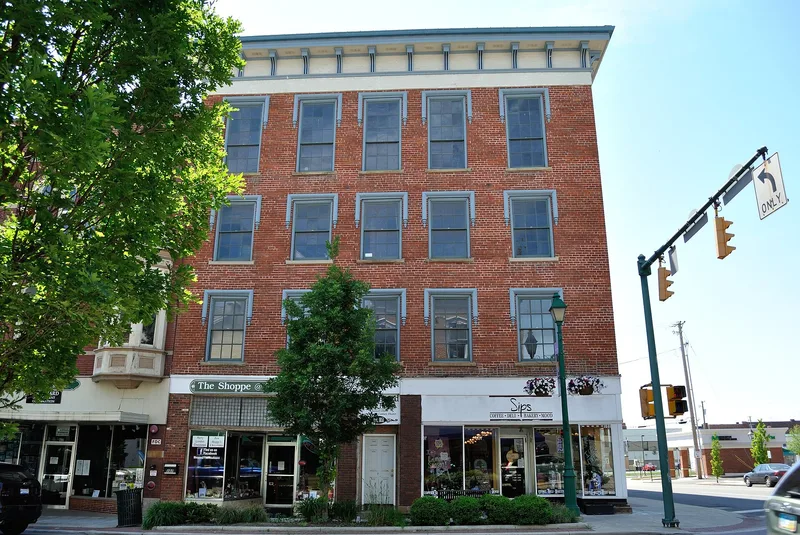

Why it's listed
Rising four stories at the corner of Main and Vine Streets in Mount Vernon, Ohio, this red brick building was constructed in 1851-52 on land leased to Ebenezer G. Woodward for a fire wall. A men's clothing store has occupied the ground floor from the start, while the third and fourth floors held Woodward Hall, later called the Woodward Opera House. The hall opened in 1853 with a lecture on phrenology and went on to host operas, plays, lectures, minstrel shows and vaudeville. Local musician Daniel Decatur Emmett, credited with creating minstrelcy and composing "Dixie", appeared at a minstrel show there late in his life. The building has a bracketed cornice, hood-molded windows and arched stage-end windows. Inside, the theater retains painted stencils, wallpaper and a gessoed ceiling medallion with stars and musical instruments. The hall closed in 1925 after use as an Ohio Guard drill hall. Plans called for an art guild hall and a minstrelsy Hall of Fame.
Significance in brief: It is presented as an excellent mid-nineteenth century commercial building and opera house. Woodward Hall opened in 1853 and hosted lectures, plays, minstrel and vaudeville shows. It is linked to Daniel Decatur Emmett, credited with creating minstrelcy and writing "Dixie".
Machine-generated summary. This summary was generated by a language model from the official nomination document and has not been reviewed line by line by an editor. It may contain errors. Check the source document before relying on any detail. Source: nomination document (PDF) · National Archives catalog entry. NRHP reference 75001448, listed October 10, 1975. Summary generated October 2026 (model claude-sonnet-5-5, prompt v1.0-2026-10-29, confidence medium).
Key facts
| Address | Main and Vine Sts., Mount Vernon |
|---|---|
| County | Knox County |
| Listed | October 10, 1975 |
| Reference number | 75001448 |
| Resource type | Building |
| Period of significance | 1800-1899 |
| Architectural style | Italianate |
| Areas of significance | Performing Arts |
| Level of significance | Local |
| Status (as stated in the nomination) | Ground-floor commercial use continues; the upper floors are vacant or empty, the theater floor and balcony are empty, and the opera hall was closed in 1925. |
| Acreage | 0.9 |
| Within district | Downtown Mount Vernon Historic District |
| Coordinates | 40.39251, -82.48588 (NPS GIS) |
What listing means for this property
National Register listing is honorary for a privately owned home: it does not by itself restrict what an owner may do with their own money, and it does not require public access. Restrictions come from local landmark or historic-district ordinances, which are separate (how they differ).
Owner-occupied houses are not eligible for the 20% federal rehabilitation tax credit, which applies to income-producing buildings, but many states offer credits for homeowners. Listing also opens the door to preservation easements and to buying a plaque. Start with what listing means for homeowners, renovating a listed house and selling one.
General information, not legal or tax advice. Rules change; confirm with your State Historic Preservation Office or a qualified adviser.
Sources and further reading
- National Park Service, National Register of Historic Places database (snapshot May 2026), reference 75001448.
- Nomination form (PDF, National Archives) — catalog entry
- Wikidata Q138399326
- This listing as JSON
Last updated October 2026. Found an error? See the editorial policy for how to report it.