Nurre-Royston House
Also known as: Ham-5175-45

Why it's listed
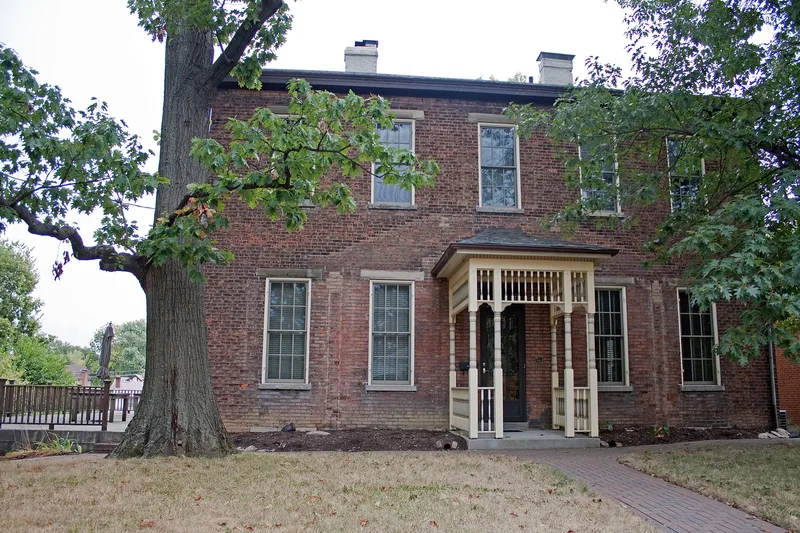
Built around 1855, this two-and-a-half story brick farmhouse at 4330 Errun Lane sits on a quiet cul-de-sac in St. Bernard, Cincinnati. The lot is now about half an acre, but it was once the middle of a 54-acre farm. Of the farm's outbuildings, only a stone springhouse fed by an active spring remains. The house follows a double-pile center hall plan, with two equal rooms on each side of a central hall on every floor, and it keeps much of its original pine flooring, trim, doors and transoms. A living room mural dating to about 1920 is a distinctive feature. The house is tied to the Nurre family, who arrived in St. Bernard in 1859 and later subdivided their farmland into housing lots as the community changed from farming to a residential suburb. It also served for over 50 years as the first stop on St. Clement Parish's annual Corpus Christi procession, and it is the earliest surviving house linked to that tradition.
Significance in brief: The nomination ties the house to the Nurre family, who helped shape St. Bernard's growth by subdividing farmland for suburban housing. It was also an altar stop on the parish's annual Corpus Christi procession for more than 50 years and is the earliest remaining house associated with that procession. The house is also an example of the double-pile center hall house type.
Machine-generated summary. This summary was generated by a language model from the official nomination document and has not been reviewed line by line by an editor. It may contain errors. Check the source document before relying on any detail. Source: nomination document (PDF) · National Archives catalog entry. NRHP reference 08001295, listed January 8, 2009. Summary generated October 2026 (model claude-sonnet-5-5, prompt v1.0-2026-10-29, confidence medium).
Key facts
| Address | 4330 Errun La., Cincinnati |
|---|---|
| County | Hamilton County |
| Listed | January 8, 2009 |
| Reference number | 08001295 |
| Resource type | Building |
| Architectural style | Other: Double-Pile Center Hall House Type |
| Areas of significance | Community Planning and Development, Social History, Exploration/Settlement |
| Level of significance | Local |
| Status (as stated in the nomination) | Used as a single dwelling; the form describes alterations including replacement windows, porches and a garage added around 2000. |
| Acreage | 0.9 |
| Coordinates | 39.16353, -84.49416 (NPS GIS) |
What listing means for this property
National Register listing is honorary for a privately owned home: it does not by itself restrict what an owner may do with their own money, and it does not require public access. Restrictions come from local landmark or historic-district ordinances, which are separate (how they differ).
Owner-occupied houses are not eligible for the 20% federal rehabilitation tax credit, which applies to income-producing buildings, but many states offer credits for homeowners. Listing also opens the door to preservation easements and to buying a plaque. Start with what listing means for homeowners, renovating a listed house and selling one.
General information, not legal or tax advice. Rules change; confirm with your State Historic Preservation Office or a qualified adviser.
Sources and further reading
- National Park Service, National Register of Historic Places database (snapshot May 2026), reference 08001295.
- Nomination form (PDF, National Archives) — catalog entry
- Wikipedia article (used for cross-checking only; text not reproduced here)
- Wikidata Q7070177
- This listing as JSON
Last updated October 2026. Found an error? See the editorial policy for how to report it.