East Fourth Street Historic District

Why it's listed
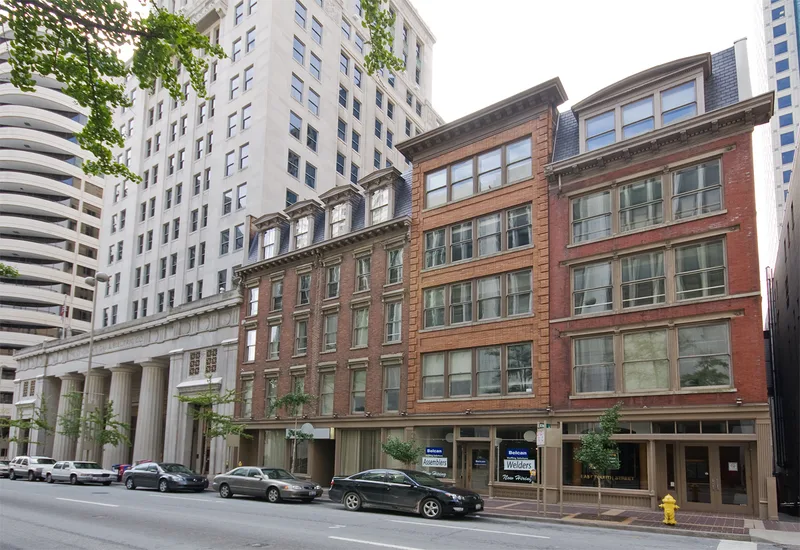
Three narrow, five-story brick commercial buildings stand together on the south side of East Fourth Street in downtown Cincinnati, at 123, 127 and 135-37. Built around 1860 as plain four-story Italianate structures, they later gained Mansard attic stories and other updates, so each now reflects a different phase of commercial style, including Second Empire, Commercial and Second Renaissance Revival features. Their matching scale, massing, materials and unified first-floor storefronts make them read as a cohesive group. They are among the few small-scale commercial buildings left from the era before 1900 to 1913, when bank and office towers remade the street into the city's financial center. The middle building was home to the John Holland Gold Pen Company from about 1860 to 1981, a maker of fine fountain pens sold worldwide. The Pounsford Stationery Company occupied 135-37 from 1876 to 1928. Rehabilitation work was restoring or sympathetically recreating the storefronts and cornices.
Significance in brief: The three buildings are among the last small-scale commercial buildings from the late 19th and early 20th century on central East Fourth Street, and they keep their historic identity while newer large buildings surround them. They also show changing commercial styles through their later remodelings. The center building housed the John Holland Gold Pen Company from about 1860 until 1981.
Machine-generated summary. This summary was generated by a language model from the official nomination document and has not been reviewed line by line by an editor. It may contain errors. Check the source document before relying on any detail. Source: nomination document (PDF) · National Archives catalog entry. NRHP reference 88000078, listed February 22, 1988. Summary generated October 2026 (model claude-sonnet-5-5, prompt v1.0-2026-10-29, confidence high).
Key facts
| Address | 123, 127, and 135--137 E. Fourth St., Cincinnati |
|---|---|
| County | Hamilton County |
| Listed | February 22, 1988 |
| Reference number | 88000078 |
| Resource type | District |
| Period of significance | 1860-1900 |
| Architect / builder | Unknown |
| Architectural style | Second Empire, Second Renaissance Revival, Italianate |
| Areas of significance | Architecture |
| Level of significance | Local |
| Status (as stated in the nomination) | Each building was being rehabilitated according to the Secretary of the Interior's Standards for Rehabilitation. Storefronts were being restored or given compatible new treatments. Current functions are listed as commerce/trade. |
| Acreage | 0.9 |
| Coordinates | 39.10215, -84.51009 (NPS GIS) |
What listing means for this property
This is a historic district. Buildings within its boundary are either contributing (they add to the district's significance) or non-contributing. Owners of contributing income-producing buildings can claim the 20% federal rehabilitation tax credit; homeowners should look at state credits. National Register districts impose no design review by themselves; a local historic district ordinance, if one exists, does (the difference explained).
General information, not legal or tax advice. Rules change; confirm with your State Historic Preservation Office or a qualified adviser.
Sources and further reading
- National Park Service, National Register of Historic Places database (snapshot May 2026), reference 88000078.
- Nomination form (PDF, National Archives) — catalog entry
- Wikipedia article (used for cross-checking only; text not reproduced here)
- Wikidata Q5328384
- This listing as JSON
Last updated October 2026. Found an error? See the editorial policy for how to report it.