Cincinnati and Whitewater Canal Tunnel
Also known as: Harrison Tunnel; Ham-4353-53

Why it's listed
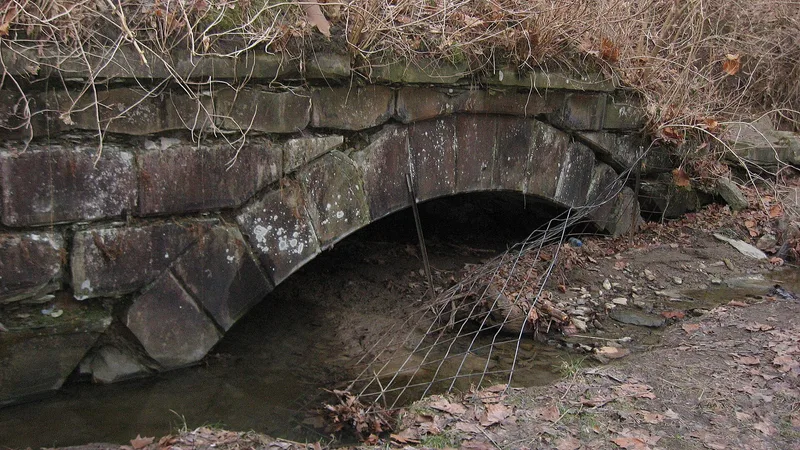
Beneath a ridge near Cleves, Ohio, a brick-lined tunnel once carried canal boats between the Ohio and Great Miami river valleys. Built for the Cincinnati and Whitewater Canal between 1837 and 1846, it originally ran 1,782 feet, lined with red brick three courses deep and fronted by cut sandstone portals with arched openings and flared wingwalls. Later it carried railroad tracks until the line was abandoned in the 1880s. Construction of U.S. 50 in 1958-1960 destroyed or buried the North Bend end and a section of the southern end, and the remainder has silted up. The Cleves portal and a long stretch of lining survive. The tunnel is considered important as the first canal tunnel built in Ohio, one of only 12 begun in the United States, and the third longest. It is also the main surviving piece of the canal, which Cincinnati helped fund with municipal tax money.
Significance in brief: The tunnel is argued to be significant under Criterion A for its link to early canal-building and municipally funded transportation improvements in Ohio. Under Criterion C it is a rare construction type: the first canal tunnel built in Ohio, one of only 12 begun in the United States, and the third longest. It is also the most significant surviving resource of the Cincinnati and Whitewater Canal.
Machine-generated summary. This summary was generated by a language model from the official nomination document and has not been reviewed line by line by an editor. It may contain errors. Check the source document before relying on any detail. Source: nomination document (PDF) · National Archives catalog entry. NRHP reference 01000562, listed May 25, 2001. Summary generated October 2026 (model claude-sonnet-5-5, prompt v1.0-2026-10-29, confidence high).
Key facts
| Address | Parallel to Miami Ave., jct. of Wamsley and Miami Ave., Cleves |
|---|---|
| County | Hamilton County |
| Listed | May 25, 2001 |
| Reference number | 01000562 |
| Resource type | Structure |
| Period of significance | 1837-1863 (canal) |
| Architect / builder | Darius Lapham (Engineer, Cincinnati and Whitewater Canal); S. and H. Howard & Company (Contractor) |
| Architectural style | Other: Brick Lined Canal Tunnel with Sandstone Portal |
| Criteria |
|
| Areas of significance | Transportation, Engineering |
| Level of significance | State |
| Status (as stated in the nomination) | Current function listed as vacant/not in use. The North Bend portal and about 290 feet of the south end were destroyed or buried during U.S. 50 construction in 1958-1960. The exposed brick lining is in good condition, the portal stonework in fair condition, and the tunnel is heavily silted. |
| Acreage | 1.3 |
| Coordinates | 39.15209, -84.75028 (NPS GIS) |
What listing means for this property
National Register listing is honorary: it recognises significance and does not restrict what a private owner may do without federal money or permits. It unlocks the 20% federal rehabilitation tax credit for income-producing buildings, state credits in many states, and Section 106 review when federal agencies are involved. See what listing means in practice.
Noted as vacant in the nomination. Nomination documents can be decades old; current status may differ. If you are considering buying an empty listed property, read the due-diligence checklist.
General information, not legal or tax advice. Rules change; confirm with your State Historic Preservation Office or a qualified adviser.
Sources and further reading
- National Park Service, National Register of Historic Places database (snapshot May 2026), reference 01000562.
- Nomination form (PDF, National Archives) — catalog entry
- Wikipedia article (used for cross-checking only; text not reproduced here)
- Wikidata Q12054997
- This listing as JSON
Last updated October 2026. Found an error? See the editorial policy for how to report it.