Becker House
Also known as: Burgoyne House; Rheinbolt Hill

Why it's listed
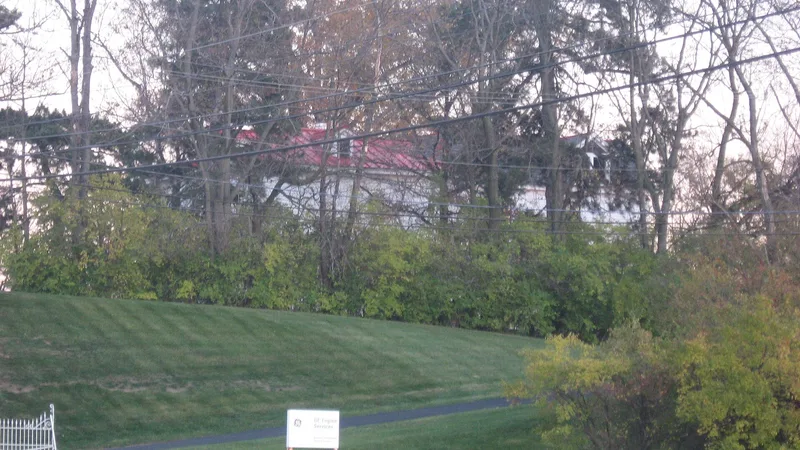
Perched on a small, landscaped hill near Springdale, this large frame house began in 1830 as a square, two-story dwelling built by Joseph Hough on a 63-acre tract. It has a low hip roof, small dormers, two-over-two windows and a one-story porch with six double posts on each side and a bracketed cornice. Around 1879 a larger L-shaped addition was attached to the rear, probably by Rudolph Rheinbolt, after whom the place was called Rheinbolt Hill. Judge John Burgoyne Sr., a known figure in Cincinnati law and politics, lived there from 1860 to 1864. He is credited with being the first on the Court of Common Pleas bench in Cincinnati to pronounce the Fugitive Slave law unconstitutional. The house was recognized for its history and as an example of a mid-nineteenth century rural homestead. It remained in excellent condition, though planned road widening threatened it at the time of listing.
Significance in brief: The nomination argues for both historic and architectural significance. Judge John Burgoyne Sr., a figure in Cincinnati law and politics, lived there from 1860 to 1864. The house typifies a mid-nineteenth century rural homestead and keeps a strong rural character amid a developing industrial area.
Machine-generated summary. This summary was generated by a language model from the official nomination document and has not been reviewed line by line by an editor. It may contain errors. Check the source document before relying on any detail. Source: nomination document (PDF) · National Archives catalog entry. NRHP reference 74001522, listed July 18, 1974. Summary generated October 2026 (model claude-sonnet-5-5, prompt v1.0-2026-10-29, confidence high).
Key facts
| Address | 179 W. Crescentville Rd., Springdale |
|---|---|
| County | Hamilton County |
| Listed | July 18, 1974 |
| Reference number | 74001522 |
| Resource type | Building |
| Period of significance | 1830-1879 |
| Architect / builder | Joseph Hough (original section, 1830) |
| Areas of significance | Architecture |
| Level of significance | Local |
| Status (as stated in the nomination) | Described as in excellent condition and used as a private residence; the form says it is threatened by the planned widening of Crescentville Road. |
| Acreage | 3.6 |
| Coordinates | 39.30203, -84.47461 (NPS GIS) |
What listing means for this property
National Register listing is honorary for a privately owned home: it does not by itself restrict what an owner may do with their own money, and it does not require public access. Restrictions come from local landmark or historic-district ordinances, which are separate (how they differ).
Owner-occupied houses are not eligible for the 20% federal rehabilitation tax credit, which applies to income-producing buildings, but many states offer credits for homeowners. Listing also opens the door to preservation easements and to buying a plaque. Start with what listing means for homeowners, renovating a listed house and selling one.
General information, not legal or tax advice. Rules change; confirm with your State Historic Preservation Office or a qualified adviser.
Sources and further reading
- National Park Service, National Register of Historic Places database (snapshot May 2026), reference 74001522.
- Nomination form (PDF, National Archives) — catalog entry
- Wikipedia article (used for cross-checking only; text not reproduced here)
- Wikidata Q4878663
- This listing as JSON
Last updated October 2026. Found an error? See the editorial policy for how to report it.