Wade Park District

Why it's listed
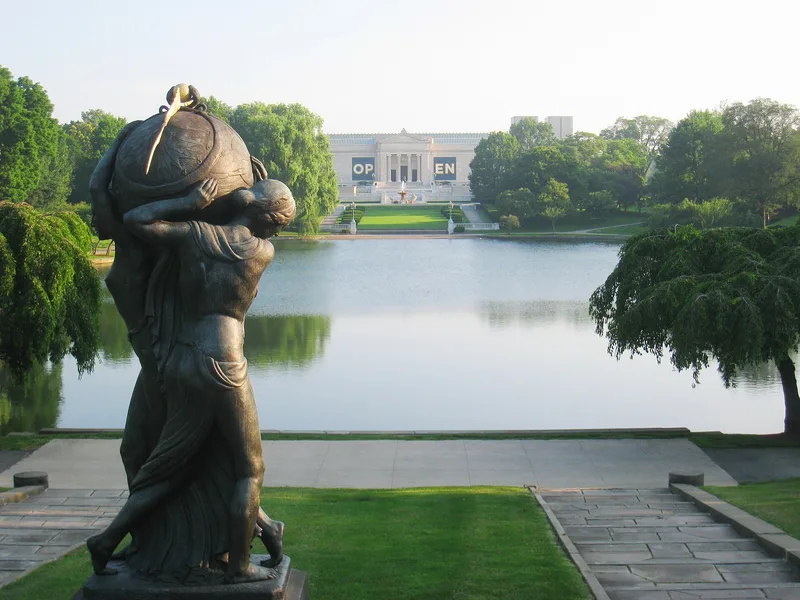
Wade Park is a 65-acre district at the center of University Circle in Cleveland, made up of greenways, landscaped gardens, a lagoon and the buildings that face them. Jeptha H. Wade, a founder of Western Union, gave the land to the city in 1882 and later set aside a tract for an art gallery. The Cleveland Museum of Art opened there in 1916. Other major buildings followed, including the Fourth Church of Christ Scientist (1918-1920), The Temple (1924), Epworth-Euclid Methodist Church (1928), two luxury residential hotels (1923) and Severance Hall (1931). The Fine Arts Garden, designed by the Olmsted Brothers firm, was carried out in 1927-1928. The district also holds sculpture by Auguste Rodin and Augustus Saint-Gaudens. Three later buildings from 1966 to 1971 are judged compatible with the setting. The district is significant for its architecture, landscape architecture and sculpture, and as an example of cultural center planning.
Significance in brief: The nomination calls the park the centerpiece of the most significant collection of cultural institutions in Ohio, and one unique in the nation. It contains or is ringed by at least seven buildings of high artistic value by nationally and locally important architects. It also holds sculpture by Rodin and Saint-Gaudens, and its Olmsted-designed Fine Arts Garden is a notable example of civic, landscape and cultural center planning.
Machine-generated summary. This summary was generated by a language model from the official nomination document and has not been reviewed line by line by an editor. It may contain errors. Check the source document before relying on any detail. Source: nomination document (PDF) · National Archives catalog entry. NRHP reference 82001372, listed October 2, 1982. Summary generated October 2026 (model claude-sonnet-5-5, prompt v1.0-2026-10-29, confidence high).
Key facts
| Address | Roughly bounded by E. 105 St., East Blvd., Chester and Euclid Aves., Cleveland |
|---|---|
| County | Cuyahoga County |
| Listed | October 2, 1982 |
| Reference number | 82001372 |
| Resource type | District |
| Period of significance | 1882-1931 |
| Architect / builder | Olmsted Brothers (Fine Arts Garden); Bertram Goodhue, George B. Post & Sons, Charles Greco, Walker & Weeks, Hubbell & Benes, Briggs & Nelson (buildings); form lists builder/architect as N/A |
| Architectural style | Mixed: Neo-Classic, Georgian Revival, French Renaissance eclectic, Modernistic-Gothic, late Romanesque revival, modern classical mannerism with Art Deco interiors; romantic-style landscape |
| Criteria |
|
| Areas of significance | Landscape Architecture, Art, Architecture |
| Level of significance | State |
| Status (as stated in the nomination) | Occupied and in use as park, museum, educational, religious and residential property. The Fine Arts Garden has suffered some neglect and vandalism but is in good condition, with efforts under way to restore it to the original Olmsted plan. |
| Acreage | 65 |
| Coordinates | 41.50836, -81.61264 (NPS GIS) |
What listing means for this property
This is a historic district. Buildings within its boundary are either contributing (they add to the district's significance) or non-contributing. Owners of contributing income-producing buildings can claim the 20% federal rehabilitation tax credit; homeowners should look at state credits. National Register districts impose no design review by themselves; a local historic district ordinance, if one exists, does (the difference explained).
General information, not legal or tax advice. Rules change; confirm with your State Historic Preservation Office or a qualified adviser.
Sources and further reading
- National Park Service, National Register of Historic Places database (snapshot May 2026), reference 82001372.
- Nomination form (PDF, National Archives) — catalog entry
- Wikipedia article (used for cross-checking only; text not reproduced here)
- Wikidata Q7959105
- This listing as JSON
Last updated October 2026. Found an error? See the editorial policy for how to report it.