Cleveland Home For Aged Colored People

Why it's listed
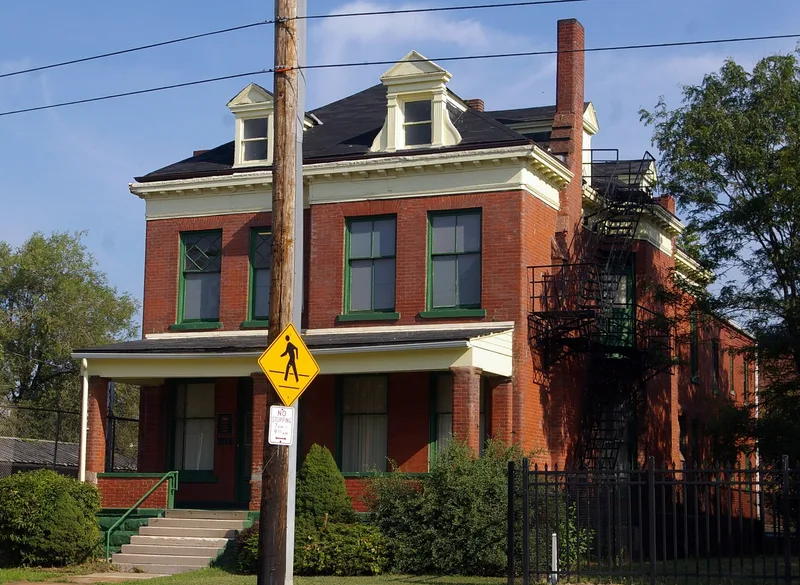
This 2-1/2-story brick house at 4807 Cedar Avenue in Cleveland was built before 1892 as a late Victorian residence with Colonial Revival touches, including pedimented dormers and modillion brackets. Projecting bays mark both side elevations, and the double-hung windows include some diamond panes. A two-story rear wing was added to provide more residential space. The house sits on a narrow city lot in an older inner-city neighborhood near the Phillis Wheatley Association and Lane Metropolitan CME Church. It became the home of the Cleveland Home for Aged Colored People in 1914 and remained so until 1967. The institution was founded in 1895 under the leadership of Eliza Bryant and had earlier occupied two smaller frame buildings that no longer survive. It was the oldest social institution for Black residents in Cleveland, and the building is valued as evidence of social concern in the late 19th and early 20th centuries. It now serves as a halfway house.
Significance in brief: The building housed the oldest social institution for Black residents in Cleveland for 53 years. It reflects late 19th and early 20th century social consciousness and the leadership of Eliza Bryant. The home was founded in 1895 and moved into this house in 1914.
Machine-generated summary. This summary was generated by a language model from the official nomination document and has not been reviewed line by line by an editor. It may contain errors. Check the source document before relying on any detail. Source: nomination document (PDF) · National Archives catalog entry. NRHP reference 82001366, listed December 17, 1982. Summary generated October 2026 (model claude-sonnet-5-5, prompt v1.0-2026-10-29, confidence medium).
Key facts
| Address | 4807 Cedar Ave., Cleveland |
|---|---|
| County | Cuyahoga County |
| Listed | December 17, 1982 |
| Reference number | 82001366 |
| Resource type | Building |
| Period of significance | 1914-1967 |
| Architectural style | Victorian - Colonial Revival |
| Criteria |
|
| Areas of significance | Social History |
| Level of significance | Local |
| Status (as stated in the nomination) | Currently used as a halfway house; interior and exterior condition described as good. |
| Acreage | 0.9 |
| Coordinates | 41.50061, -81.65378 (NPS GIS) |
What listing means for this property
National Register listing is honorary for a privately owned home: it does not by itself restrict what an owner may do with their own money, and it does not require public access. Restrictions come from local landmark or historic-district ordinances, which are separate (how they differ).
Owner-occupied houses are not eligible for the 20% federal rehabilitation tax credit, which applies to income-producing buildings, but many states offer credits for homeowners. Listing also opens the door to preservation easements and to buying a plaque. Start with what listing means for homeowners, renovating a listed house and selling one.
General information, not legal or tax advice. Rules change; confirm with your State Historic Preservation Office or a qualified adviser.
Sources and further reading
- National Park Service, National Register of Historic Places database (snapshot May 2026), reference 82001366.
- Nomination form (PDF, National Archives) — catalog entry
- Wikipedia article (used for cross-checking only; text not reproduced here)
- Wikidata Q5132162
- This listing as JSON
Last updated October 2026. Found an error? See the editorial policy for how to report it.